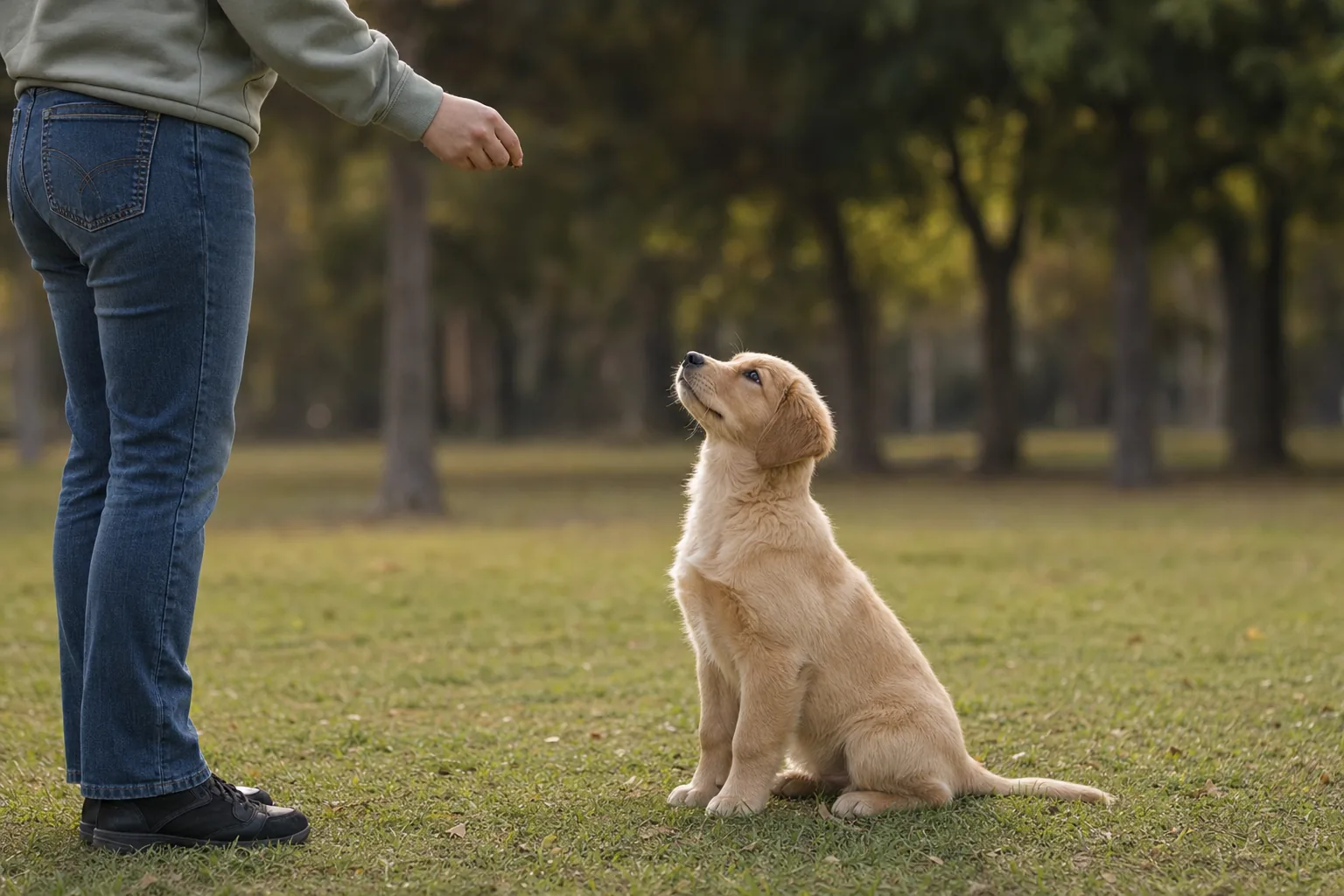
Sunday lunch, everyone round the table, and the dog has parked himself next to Grandma. Chin on her knee, eyes on her fork. After a minute he whines. A minute later a paw lands on the chair. Grandma lasts as long as she can, then says "oh, he's only little" and slips him a bit of roast under the table. Your dog may be past that stage already. He doesn't ask for anything any more; he just waits for you to leave the kitchen, stands up at the worktop and walks off with the bread. Both habits are learned at home, and both can be unlearned at home. What you need is one rule the whole family sticks to, and a place of his own where mealtimes bring him something better than crumbs under the table.
How to stop a dog begging, step by step
It helps to know where this comes from. A dog begs because now and then it works. It doesn't need to work at every meal. If it works one time in ten, he will try even harder, like someone feeding a slot machine and waiting for their turn. Worktop stealing runs the same way: at least once he found something very good up there, and every success sends him back for another look.
1. One rule for the whole house: nothing from the table
The dog gets nothing from the table and nothing off a plate. Not "just a tiny bit", not the leftovers at the end. The rule covers everyone, no exceptions, because one soft touch is enough. The dog finds that person straight away, moves next to their chair and pushes harder. Talk it through with the whole family, children and grandparents included. Guests hear the rule at the door, before they sit down.
If you still want to share something you cooked, say plain boiled lean meat or a carrot, put it in his own bowl after the meal and away from the table.
2. Set the house up so he gets no chances
While you teach him something new, make sure he can't keep practising begging or stealing. A few small changes do most of the work:
- at mealtimes he is in another room behind a baby gate, or on a short lead clipped to something solid next to his bed;
- nothing stays on the worktop: bread goes in the bread bin, meat in the fridge or a closed oven, nothing near the edge;
- chairs get pushed in when you leave the table, so he has nothing to climb on;
- the bin has a lid or lives in a cupboard.
3. His spot: the blanket where good things turn up
Pick a blanket or bed a few metres from the table where he can still see you. Practise when nobody is eating:
- Toss a treat onto the blanket. When he steps on it, praise him and drop another one on the blanket.
- Wait for him to lie down there on his own. When he does, put one or two treats between his front paws.
- Only now add a word, "on your bed", said just before he heads for the blanket.
- Build the time slowly: a few seconds, a minute, then five. Every so often walk over calmly and leave a treat on the blanket.
- Get up, wander round the room, come back. If he's still on the blanket, he gets a treat.
Ask for it at mealtimes only once it works well with no food on the table.
4. At mealtimes, he gets something better
As you sit down, he gets something on his blanket that will keep him busy. A frozen stuffed toy, a chew that suits his size, or part of his daily ration hidden in a snuffle mat all work. The family meal turns into the moment he gets the best thing of his day, just well away from the table.
5. For worktop stealing: "leave it" and four paws on the floor
Teach "leave it" on its own, at a different time. Hold a treat in a closed fist. He will nudge, lick, maybe paw at it. The second he backs off, he gets a different treat from your other hand. Then try it with an open palm, then with the treat on the floor, then on a low chair.
In the kitchen you work the other way round. Whenever he stands beside you with all four paws on the floor while you cook, let a treat drop from your hand to the floor. Within a few days he works out that food arrives on the floor and the worktop has nothing to offer.
Puppies, adolescents, adults and seniors
Puppies. Easiest of all is to never let it start. From day one he gets nothing from the table, and at mealtimes he's busy with his stuffed toy or asleep in his pen. Puppies learn very fast where the good stuff happens.
Adolescents. He shoots up and finds he can reach the worktop. This is usually when stealing begins. How you've set up the house matters hugely now, along with plenty of exercise: a bored adolescent goes looking for entertainment, and the worktop is the nearest source.
Adults. A dog who has begged for years will beg harder for the first few days after the titbits stop. We're always glad to see that, because it means he's noticed the change. If the whole family holds firm, the begging drops after that peak.
Seniors. In older dogs, more begging can come from illness. Some hormonal conditions, diabetes and some medicines make dogs hungrier. It can also be boredom, as they have less to do. If his appetite has changed suddenly, take him to the vet. Otherwise it's the same plan, with a softer, warmer blanket.
The mistakes we see most often
"Just this once." To a dog, one time in ten is reason enough to try at every meal.
Giving him something to keep him quiet. You've just taught him that whining and barking open the plate. Next time he starts earlier and louder.
Telling him off. "No! Go away!" is attention too, and for some dogs that beats being ignored. With worktop stealing, telling him off afterwards achieves nothing. He links it to you walking into the kitchen, not to the bread he ate five minutes ago.
Booby traps on the worktop, such as trays that fall, sprays or loud noises. A sensitive dog can end up scared of the whole kitchen and still learn nothing about where he should be. We don't recommend them.
Scraps in his bowl during the meal. If his scraps go into a bowl beside the table, the begging stays beside the table too.
Food left on the worktop "just for a minute". For a dog who has stolen before, a minute is plenty.
How long it takes and how you'll know it's working
If the whole family keeps the rule, begging drops noticeably within two or three weeks. The first few days can be worse than before, as he tries everything that used to work on each of you. Worktop stealing is more stubborn: one lucky find every now and then keeps him keen for weeks. That's why a clear worktop stays a house rule after the training is done.
You'll notice it in small things. When he sees the table being laid, he takes himself off to his blanket. He no longer turns up under the table at the end of the meal. In the kitchen he stands next to you, paws on the floor, watching you instead of the worktop. When someone gets up from the table, he stays where he is.
| Week |
What you do |
| 1 |
The whole family keeps the rule. Gate or short lead at mealtimes. Clear worktop. Blanket practice a few times a day, no meal involved. |
| 2 |
At every meal he's on his blanket with a stuffed toy. "Leave it" practised separately. |
| 3 |
Blanket without the gate, with someone keeping an eye on him. Treats in the kitchen for four paws on the floor. |
| 4 onwards |
Guests arrive: the rule at the door, the dog on his blanket with his toy. |
When to bring in a trainer
- he growls or bites when someone comes near while he's eating or holding something he's stolen (that's resource guarding, which has its own guide);
- he jumps up at people at the table, persistently, and the plan above isn't stopping it;
- he steals food or objects all the time and swallows them, which puts him at risk of poisoning or a gut blockage;
- he suddenly seems far hungrier than before (in that case, see your own vet first).
A trainer who works with rewards can help you take "on your bed" all the way to the hardest version: a festive meal, guests and full plates.