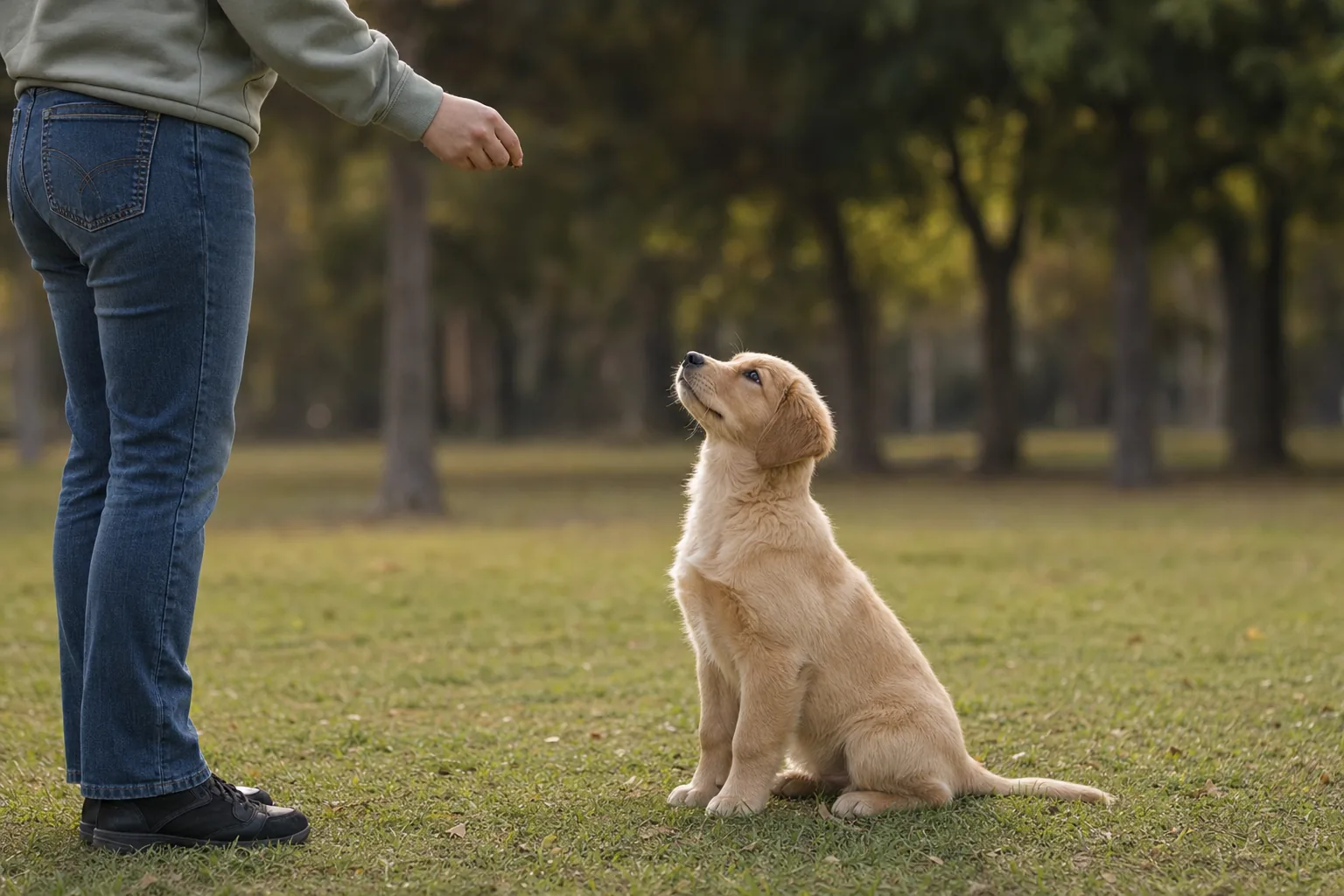
Seven in the evening, a pan on the hob, and the doorbell goes. Your dog gets there before you do, barking like a sheepdog guarding the flock, all eight kilos of him. You open the door with a knee across his chest, the courier holds the parcel out at arm's length and leaves fast. Or you live on the second floor and every lift door, every footstep on the stairs, the neighbour taking the bins down at eleven at night sets off the same concert. Or a doorbell in a film is enough to launch him off the sofa. Barking at the door is one of the things people write to us about most, and it mends better than almost anything else, because the situation never changes: a sound, a door, someone on the other side. We have a separate page on barking in general. This one is just the exercise for the doorbell, the door and the stairwell.
The exercise, step by step
The whole plan rests on one idea: the doorbell and the footsteps on the stairs come to mean "treats are about to land on my mat". A dog running to his mat cannot also be running to the door. You give him something to do instead of just asking him to be quiet.
1. Set the house up first
Every courier he barks at is one more rehearsal, and the dog gets more practice than you do. While you are working on it, for the first few weeks:
- ask friends and couriers to phone instead of ringing; a note on the door does most of the work;
- put a baby gate between the hall and the rest of the flat, so he cannot reach the door;
- move his bed away from the entrance, to a room at the back;
- in the evening, a radio or a fan covers the footsteps and the lift.
2. His mat
Separately, with no doorbell anywhere, teach him to go to a mat or a dog bed.
- Put the mat down. When he steps on it, a treat on the mat. When he lies down, another. While he stays, a few more, one at a time.
- After a few sessions say "place" before he sets off and toss the treat onto the mat; he follows it.
- Then say "place" and wait. He goes by himself, and the treat arrives once he is there.
- Move the mat to its permanent spot: three or four metres from the door, where he can see it without being glued to it. Practise there, from further and further away.
3. The bell means treats
Record your own doorbell on your phone, or find a sound close to it. The dog is on his mat or beside you.
- Play the sound so quietly you can barely hear it. Straight away, a shower of treats on the mat: five or six, one after another.
- Repeat a few times a day and nudge the volume up a little each time. If he barked, it was too loud; next time turn it down.
- After a few days, at the sound, he looks at you or heads for the mat instead of the door. Now say "place" right after the bell.
- Then the real bell, pressed by someone already inside the house, with the door shut. Bell, "place", treats on the mat.
4. The door opens
Only now does a helper ring from outside. You say "place", he goes to the mat, gets his treats. You walk to the door, put a hand on the handle, come back to him with a treat. Next time you open it a crack. Then all the way, and the helper steps in and out. Once he stays on the mat with the door wide open, the helper comes into the house, and the dog greets them only after he has settled, on a lead to begin with.
5. One bark is fine
One or two at the bell are an honest announcement. Say "thanks, I heard", in an ordinary voice, and call him to the mat. A dog who barks once and then runs to his mat, eyes out for treats, is a job well done.
6. The stairs and the neighbours
The hard part, because you do not pick the moment.
- Whenever you hear footsteps, the lift or a door slamming, before he barks, scatter a few treats on the floor near him or on the mat. Searching keeps his nose on the floor. Within a few weeks, footsteps on the stairs mean "there's something good to find".
- If he has already barked, do not shout. Call him into another room, praise him when he comes, give him a treat and a chew.
- Background noise and a bed moved away from the door do half the work with the evening neighbours.
The first week
| Day |
What you do |
| 1 |
Note on the door, gate in the hall, bed moved. Record the doorbell. |
| 1-3 |
"Place" on the mat, three times a day for two minutes, no bell. |
| 3-5 |
The recorded bell, quietly, followed by treats on the mat. Volume goes up only when he does not react. |
| 4-7 |
Treats on the floor at every noise from the stairs, before he barks. |
| 7 |
The first real bell, pressed by someone in the house. Count the barks and the seconds until he reaches the mat. |
By age
Puppies. Everything is new to him, and that works in your favour. From the first days, the bell (recorded first, then real) comes with treats, and guests greet him only when all four paws are on the floor. Puppies rarely bark at the door in their first months; the habit comes later, so you have time to stop it ever starting.
Adolescents (6-18 months). This is when alarm barking appears and many dogs start to care about territory. Your quiet puppy who suddenly took up barking at the door at eight or nine months is doing what plenty of dogs do. Start the exercise now, while the habit is weeks old rather than years.
Adults. The habit is old, so step 1 carries even more weight: every bell he barks at while you are working sets you back. Be patient with the volume. With a dog who has barked at the bell for five years, the first days are done almost in a whisper.
Seniors. Old dogs who start barking at the door at night for no reason, or who no longer hear the bell and get a fright when someone walks in, have a different problem. Hearing goes, sight goes, some become confused. Talk to your vet; sometimes a visual signal, a light switched on and off, stands in for the bell.
Common mistakes
- Shouting. To the dog, you are both barking now. You have confirmed that something serious is happening at the door.
- Anti-bark collars, spray, vibration or shock. They stop the sound without touching the reason, and the dog links the unpleasantness with the bell and with the people coming in. In dogs who bark from fear, it can end in growling and a bite.
- Opening the door with the dog beside you. Every time he gets to jump on a guest is a huge reward for everything he did beforehand.
- Guests greeting him while he barks or jumps. Ask them to ignore him until he is on his mat.
- Treats after five minutes of barking, to make him stop at last. He learns that long barking brings food. Treats come when he goes to the mat or, for noises on the stairs, before he barks.
- Jumping straight to the courier. You cannot go from a whispered recording to a real courier in one step. He has no way to get it right.
- The bed in the hall. A dog who sleeps on the doormat is on guard duty 24 hours a day.
How long it takes and how you know it is working
For a puppy or an adolescent, two to three weeks until the recorded bell sends him to his mat on his own. For an adult with an old habit, four to eight weeks to the real bell, with guests. The stairwell takes longest, because the noises come unannounced; there, progress is measured in the seconds until he stops.
The signs it is working, in the order they appear: at the bell, his head turns to you before his legs head for the door; he barks once or twice instead of for a minute; he runs to the mat without being told; at footsteps on the stairs he pricks his ears and looks on the floor for treats; guests come in and he greets them after the door has shut rather than on the threshold. Once a week, note how many barks there were at the bell and how long they lasted. The numbers fall faster than your impression does.
When to call a trainer
- he growls, lunges or has bitten someone coming into the house;
- he barks at the door with his body pulled back, tail low, ears flat: that is fear, not excitement;
- he barks at every noise in the building, for minutes on end, day and night, and the neighbours have already complained;
- after six weeks of steady work you have not got past the recorded bell;
- barking at the door is only one piece of a bigger problem: he also barks at the window, at passers-by, when you leave the house.
A trainer who comes to your home sees exactly what happens at the door and shows you how to match your movements to your dog's. For dogs who bark at people from fear, the plan has to work on the fear itself; the doorbell is only one piece of it.