
Trail Journal Case 006
The cat with white paws
Lia wanders off from outside her block of flats after a cat. Later, she draws the window of the room where Boro found her. Can you identify the place from her drawing?
Mill Lane · Saturday
Five minutes outside the flats
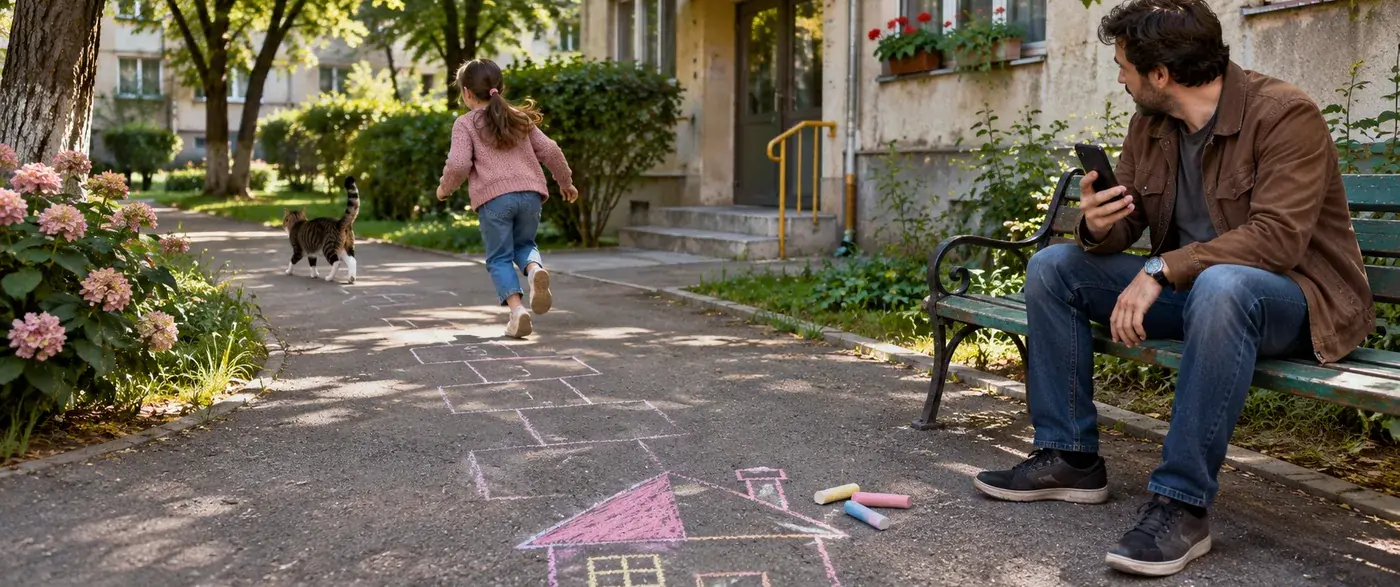
Lia is drawing with chalk outside the block of flats, next to the bench where her father is sitting. When his phone rings, he answers and looks away. A tabby cat with white paws walks past the hopscotch. Lia gets up and sets off after it. Five minutes later, her father hangs up. On the tarmac there is a hopscotch square left half coloured in.
The cat goes into an abandoned building in the yard of the old factories. Lia follows it into a room. Behind her, the door slams shut. She presses the handle, but the door has jammed. She sits down by the window and calls for her father.
Her father calls the police. The officers look for her among the blocks of flats, talk to the neighbours and ask a mantrailing team for support. Boro, the team's dog, is trained to follow the scent of one particular person. Her father gives Boro's handler the cap Lia left on the bench. Boro sniffs it, picks up the girl's trail and leads the team from outside the flats to the door Lia is stuck behind. The officers open the door, and Boro goes in with his handler and comes up beside the little girl.
Later, Lia draws the window she waited beside. It has straight sides and an arched top. In the case file you have three photographs, one from each abandoned building. One shows the room where Lia was stuck. Each photograph shows a different kind of room and a window of a different shape. In which building and in which room did Boro find Lia?
Search log
Field clues
I need a hint
Start with the two notes about the mill. Which room and which window shape can you put on the same row?
One more hint
The round window is already at the mill. If the printing works doesn't have the arched one, which shape is left for it? Then look for the room with that shape.
Workbook
Deduction grid
The grid is optional. You can use it to organise your notes and see which options you have ruled out. If you already have the answer, go straight to the final report.
For the first photograph, find the row Mill and the column Round. Tap their cell twice to confirm the pairing.
How to play: the basics and a worked example
What do I have to do in a case?
- Read the story and the question in the final report: Where did Boro find Lia? That tells you what you have to reconstruct.
- Take the clues one at a time. Look for the two items each sentence links and note in the grid what you have learned. Then tick the clue so you remember you have used it. You can reread it at any time.
- If two clues share an item, follow it through both pairings. When you get stuck, you can open “I need a hint”, then “One more hint”.
- When you have a theory, choose the building and the room in the final report. You can submit the report even if you've left the grid empty. Then press “Check the report”. If the answer doesn't match, reread the clues and try again. Once it is confirmed, read the explanation in “The log, reconstructed”, shown below the report.
How do I correct a mark?
Tap the same cell to go through the three states, in order. You start from a dot. One tap puts ×, another puts ✓, and a third brings the dot back. So from ✓, a single tap clears the mark. The other cells only change when you tap them yourself.
How do I read the big grid in a case?
Above the columns you will see categories such as “Room” and “Window”. The rows are on the left. Follow the name on the row across to the column you are interested in and read the pairing as a question. A dot means you haven't noted the answer yet.
The one-match rule applies within each group of columns. After a ✓ you can put × in the other cells on the row and the column of the same group. In another group, the same row can have one more ✓.
Further down, the rows compare the remaining categories with each other. The hatched areas show pairings already covered elsewhere in the table. On a phone, swipe the table sideways to see the next group.
The example below is a made-up case with two dogs, Luna and Nori, who ended up in different places. The first clue says: “Luna did not finish the trail at the jetty.” Luna gets × under Jetty, so the greenhouse is all that is left for her and she gets ✓ there. The second clue says: “The team that reached the greenhouse used the bandana.”
| Reference | Place | Article | ||
|---|---|---|---|---|
| Jetty | Greenhouse | Bandana | Scarf | |
| Luna | ruled out | confirmed | confirmed | unknown |
| Nori | unknown | unknown | unknown | unknown |
| Jetty | Unused group of cells | unknown | unknown | |
| Greenhouse | confirmed | unknown | ||
On the “Greenhouse” row, the ✓ under “Bandana” comes straight from the clue. On the “Luna” row, the ✓ under “Bandana” is your own conclusion: Luna reached the greenhouse, and the team at the greenhouse used the bandana. The two ticks on Luna's row are in different groups.
Swipe the table to the left to see all the columns.
| Reference | Room | Window | ||||
|---|---|---|---|---|---|---|
Final report
Where did Boro find Lia?
The log, reconstructed
- At the mill, it was the office that was photographed. Its window is round.
- That leaves the square and arched shapes for the printing works. The architect rules out the arched one, so the printing works has the square window. The sketch puts it in the changing room.
- That leaves the storeroom at the textile works. It has the arched window Lia drew. That is where Boro found her.
| Window | Building | Room |
|---|---|---|
| Round | Mill | Office |
| Square | Printing works | Changing room |
| Arched | Textile works | Storeroom |
Her father is waiting for Lia in the yard. When he picks her up, blue dust settles on his sleeve. She is still clutching a little piece of chalk in her fist.
Solve another case
More cases of the same level from the collection.
-
 Case 007
Solved
Beyond the fence
There is a board missing from the fence at the back of the garden. On the other side the forest begins, and Tudor wants to see where the path leads.
-
 Case 008
Solved
The Gate on the Lane
The lamps have come on in the village. Ema opens the front door, crosses the yard and finds the gate open.
-
 Case 009
Solved
One Last Call from the Forest
Dinu has enough battery left for a single call. His friends at the camp hear his voice, then the line goes dead.