
Trail Journal Case 007
Beyond the fence
There is a board missing from the fence at the back of the garden. On the other side the forest begins, and Tudor wants to see where the path leads.
At the edge of the forest · Thursday
The gap under the hazel
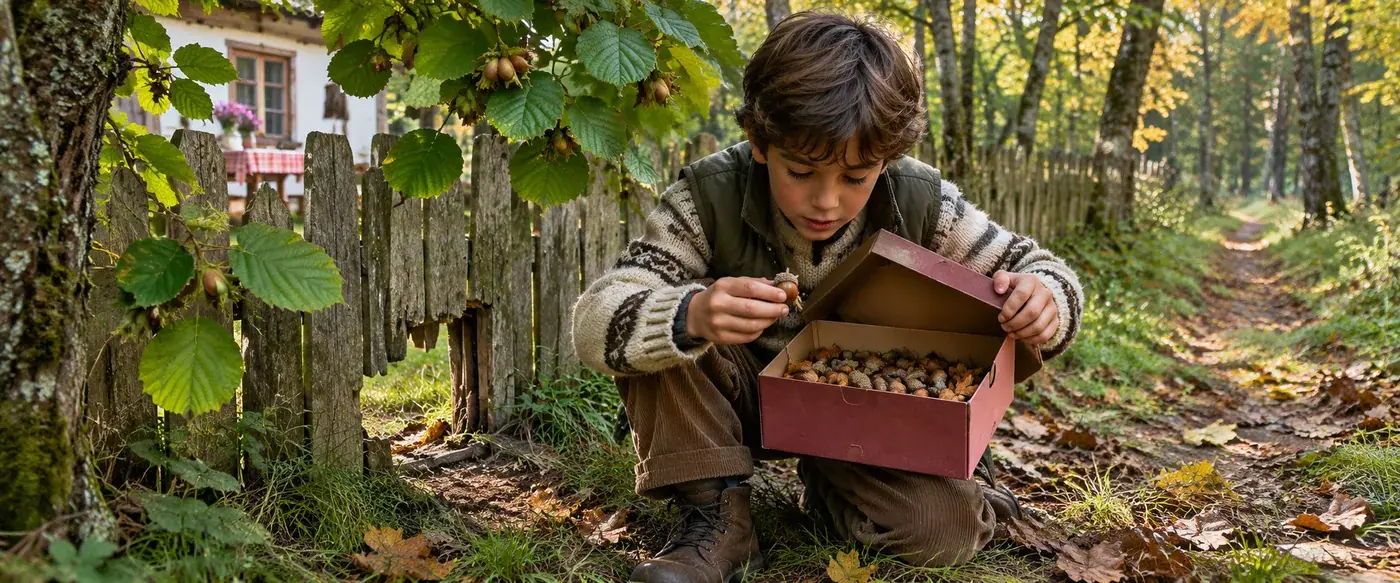
Tudor is filling a shoebox with acorns. Grandma has gone indoors to lay the table, and nobody is keeping an eye on him in the garden any more. Under the hazel, the boy finds a hole in the fence. He squeezes through it, box and all, and sets off along the forest path. At the edge of the trees, Tudor lifts the lid of the box a little. Inside, the acorns have started to jump with every step. At home he wanted to count them on the table with Grandma; here he finds there are more hiding under the leaves, with their cups still on.
When Grandma calls him in to eat, all she hears is the leaves. The family calls the police, and a search and rescue team arrives at the gate with Mira, a dog trained for mantrailing. Grandma gives Mira's handler the gilet Tudor had worn that morning. Mira sniffs it, picks up the boy's trail from the garden and finds him in the forest, sitting beside a sign with a stag on it. He has a single acorn left in the box.
There are three signs along the children's path, one each at the spring, at the footbridge and in the clearing. Each is a different colour and has a different animal painted on it. Tudor remembers the stag. What colour was the sign, and at which landmark did Mira find him? The forester's field sheets give you the four clues.
Search log
Field clues
I need a hint
Link the first two notes. Which animal and which colour can you put at the spring?
One more hint
If blue is already at the spring and yellow cannot be at the footbridge, where does that leave yellow?
Workbook
Deduction grid
The grid is optional. You can use it to organise your notes and see which options you have ruled out. If you already have the answer, go straight to the final report.
Find the row Spring and the column Otter. Tap their cell twice to confirm the pairing from the notes.
How to play: the basics and a worked example
What do I have to do in a case?
- Read the story and the question in the final report: What colour was the sign with the stag, and at which landmark was it? That tells you what you have to reconstruct.
- Take the clues one at a time. Look for the two items each sentence links and note in the grid what you have learned. Then tick the clue so you remember you have used it. You can reread it at any time.
- If two clues share an item, follow it through both pairings. When you get stuck, you can open “I need a hint”, then “One more hint”.
- When you have a theory, fill in the two boxes in the final report. You can submit the report even if you've left the grid empty. Then press “Check the report”. If the answer doesn't match, reread the clues and try again. Once it is confirmed, read the explanation in “The log, reconstructed”, shown below the report.
How do I correct a mark?
Tap the same cell to go through the three states, in order. You start from a dot. One tap puts ×, another puts ✓, and a third brings the dot back. So from ✓, a single tap clears the mark. The other cells only change when you tap them yourself.
How do I read the big grid in a case?
Above the columns you will see categories such as “Landmark” and “Animal”. The rows are on the left. Follow the name on the row across to the column you are interested in and read the pairing as a question. A dot means you haven't noted the answer yet.
The one-match rule applies within each group of columns. After a ✓ you can put × in the other cells on the row and the column of the same group. In another group, the same row can have one more ✓.
Further down, the rows compare the remaining categories with each other. The hatched areas show pairings already covered elsewhere in the table. On a phone, swipe the table sideways to see the next group.
The example below is a made-up case with two dogs, Luna and Nori, who ended up in different places. The first clue says: “Luna did not finish the trail at the jetty.” Luna gets × under Jetty, so the greenhouse is all that is left for her and she gets ✓ there. The second clue says: “The team that reached the greenhouse used the bandana.”
| Reference | Place | Article | ||
|---|---|---|---|---|
| Jetty | Greenhouse | Bandana | Scarf | |
| Luna | ruled out | confirmed | confirmed | unknown |
| Nori | unknown | unknown | unknown | unknown |
| Jetty | Unused group of cells | unknown | unknown | |
| Greenhouse | confirmed | unknown | ||
On the “Greenhouse” row, the ✓ under “Bandana” comes straight from the clue. On the “Luna” row, the ✓ under “Bandana” is your own conclusion: Luna reached the greenhouse, and the team at the greenhouse used the bandana. The two ticks on Luna's row are in different groups.
Swipe the table to the left to see all the columns.
| Reference | Landmark | Animal | ||||
|---|---|---|---|---|---|---|
Final report
What colour was the sign with the stag, and at which landmark was it?
The log, reconstructed
- The otter is at the spring, on a blue background.
- The owl is at the footbridge. Its background can be neither yellow nor blue, so it is green.
- That leaves yellow and the stag for the clearing. That is where Mira found Tudor.
| Animal | Colour | Landmark |
|---|---|---|
| Otter | Blue | Spring |
| Owl | Green | Footbridge |
| Stag | Yellow | Clearing |
At the table, Tudor takes the last acorn out of his pocket and gives it to Grandma. “This one was for you.”
Solve another case
More cases of the same level from the collection.
-
 Case 008
Solved
The Gate on the Lane
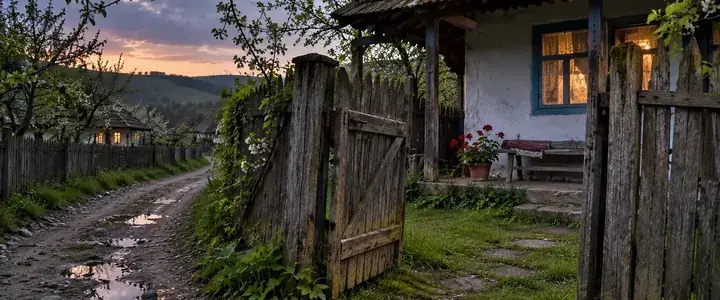
The lamps have come on in the village. Ema opens the front door, crosses the yard and finds the gate open.
-
 Case 009
Solved
One Last Call from the Forest
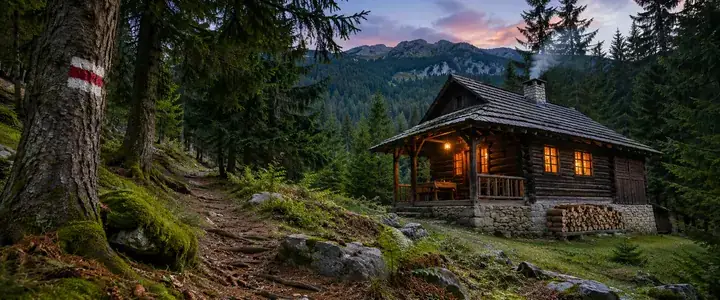
Dinu has enough battery left for a single call. His friends at the camp hear his voice, then the line goes dead.
-
 Case 010
Solved
Beyond the Pumps
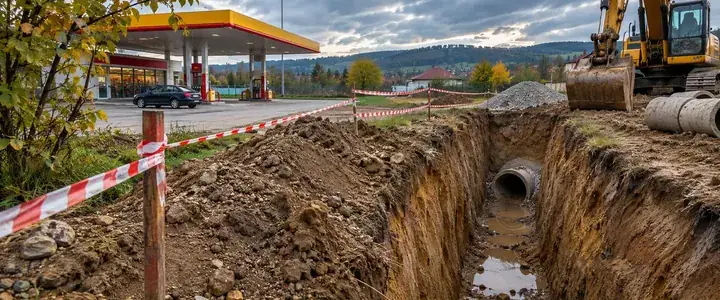
The petrol station camera catches Vlad getting out of the car. Beyond the last pump, the streets fork towards three building sites and the forest.