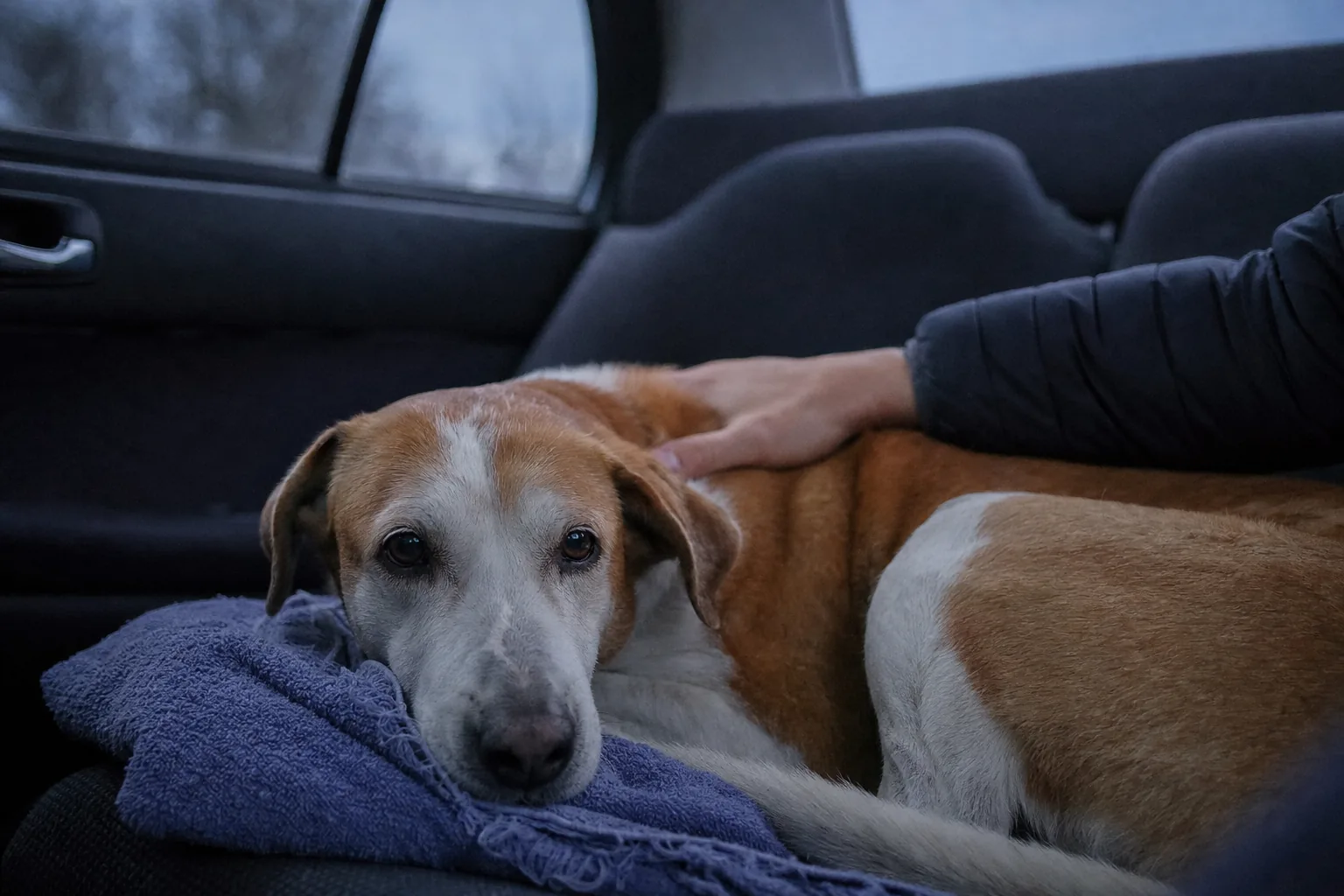
Emergency. Do not put your hands between fighting dogs; put an object between them. Afterwards, press a clean compress on any bleeding wound for 5 to 10 minutes, get the other dog's details and rabies status and see your vet today. A wound on the chest or belly, or laboured breathing: go now.
Noticed something different about your dog? Go straight to their vet.
Call your own vet or the nearest clinic with an emergency service now, and set off. Do not ask a group what to do: every answer you wait for there is time lost for the dog.
- The same sign, dozens of causes. A dog that vomits may have eaten grass or may have an object stuck in the gut. From two lines you typed, nobody can tell which. The vet feels the abdomen, takes the temperature, runs tests.
- Nobody on the internet sees your dog. They see a photo and a story. A diagnosis comes from an examination and investigations, not from a resemblance to someone else's dog.
- In groups you hear from the people whose dog "got better on its own". Those for whom it ended badly rarely post again. What you read there is a selection, not a statistic.
- Doses are calculated by weight and species. Human medicines that look harmless, paracetamol or ibuprofen, are toxic to dogs. "I gave mine half a tablet" is the most dangerous advice you can get.
- Hours matter. With a twisted stomach, a poisoning or a urinary blockage, the time spent asking online is exactly the time that decides the outcome.
- The vet is accountable for what they say. They have your dog's record, history, vaccinations, past treatments. An anonymous account has none of that and answers for nothing.
Use this page to know what to observe, what to note and what to ask at the appointment, not to treat at home. If you still have doubts after a consultation, ask another vet or a specialist (dermatologist, internist) for a second opinion, not a group. And if you do not have a regular vet yet, find one now, while your dog is healthy: how to choose a veterinary clinic.
It was over in three seconds. An off-lead dog came charging down the path, they sniffed, then a growl, a ball of fur and your dog screaming. Now they are apart. The other owner is apologising or, worse, has already gone, and you are searching your dog's coat for blood. You find two small holes on his neck and it does not look like much. Almost always, what is under the skin is worse than what you see on top. Below: what to do now, what to tell your vet and how to cut the chances of it happening again, including what to do about the fear your dog may carry with him from now on.
What to do in the next 10 minutes
If they are still fighting
- Do not put your hands between them and do not grab collars, heads or necks. In the middle of a fight a dog bites anything moving near his mouth, his own owner included. Plenty of owners get bitten exactly this way.
- Get something between them: a rucksack, an open umbrella, a bin lid. You can throw a blanket over their heads, a bucket of water or a blast from a hose.
- If there are two of you, each person takes one dog by the back legs, high up near the hips, lifts him like a wheelbarrow and backs away in a circle so he cannot turn round and bite. Do not pull while the other dog still has a firm grip, because you will tear the tissue even more.
- Once they are apart, keep them well away from each other and out of sight, round a corner or behind a car. Yours goes on a short lead.
Straight afterwards
- Check yourself first. If you were bitten, wash the wound with soap and water for a few minutes and see your GP or go to A&E today. Dog bites on people often get infected.
- Check your dog from nose to tail in good light. Part the fur with your fingers, especially on the neck, around the ears, on the chest and belly, the front legs and the base of the tail. Bites often look like small holes with hardly any blood, hidden in the coat.
- Mind your hands: a hurt, frightened dog can bite his own owner. Speak quietly. If you need to, make a muzzle from the lead or a scarf, but only if he is breathing normally and not vomiting. Never if his face is injured.
- If it is bleeding, press on it for 5 to 10 minutes with a compress or a clean cloth, without lifting to look. If it soaks through, put another on top. Do not use a tourniquet.
- If the wound is on the chest or belly and you can see air bubbles or organs, or he is breathing hard, cover it with a clean, damp cloth without pressing hard, and go now.
- Get the other owner's details: name, phone number, whether their dog is vaccinated against rabies, a photo of the dog and of the vaccination record if they have it on them. If they have left, note where, when, what the dog looked like and who saw it. You need all of this for the vet, for rabies and possibly for compensation.
- Ring your vet and tell them where the wound is, how big the dog that bit him was and how big yours is. The size difference matters enormously. A big dog shaking a small one causes deep damage under skin that looks almost intact.
What to tell the vet and what they will do
Any bite that has broken the skin should be seen by a vet the same day. A dog's mouth is full of bacteria, and small puncture wounds seal over quickly at the surface and trap the infection inside. An abscess usually shows up two to five days later as a hot, painful swelling, with a temperature.
On the phone
- where the wounds are and how many;
- whether they are bleeding, how much and for how long;
- how he is breathing, whether he can stand, whether he is limping;
- how big the other dog was;
- whether your dog and the other one are vaccinated against rabies;
- what time it happened.
At the clinic
- The vet looks at the overall picture first: breathing, pulse, gum colour, pain. In a small dog shaken by a big one they also look for internal injuries, broken ribs, air in the chest.
- They clip the fur widely around every hole and clean it so they can see everything. They often find more wounds than you did.
- They explore the wounds, often under sedation or anaesthetic, to see how deep the teeth went and whether the skin has come away from the muscle over a large area, as happens when a dog is shaken.
- They flush the wounds thoroughly and remove dead tissue.
- They decide whether to close the wound. Many bites are not stitched straight away, because a wound closed over bacteria turns into an abscess. Sometimes they place a drain for a few days.
- They take X-rays when the bite is on the chest, belly or legs, to check ribs and bones and whether air has got in.
- They choose treatment for infection and for pain. The pain after a bite is considerable, even when the wound looks small.
- They tell you what needs doing about rabies, based on both dogs' vaccinations. In Romania rabies exists in wildlife, and an up-to-date vaccination is the difference between a note in the records and a period of observation. Rules differ from country to country, so follow your vet's advice.
- They will want to see him again in two or three days, for the drain and to check for infection. The protective collar (the cone) stays on as long as the vet says, even if he sulks.
Ask for a written record of the diagnosis and treatment. If the other dog was off the lead or attacked, its owner is liable for the damage, and the vet's paperwork is your evidence.
How to prevent a fight
What you see beforehand
Dog fights rarely come out of nowhere. Usually, a few seconds before, one or both dogs:
- freeze, body still, eyes fixed;
- raise the hair along the back and the scruff;
- hold the tail high and stiff, sometimes with only the tip moving;
- put their head or a paw over the other dog's shoulder;
- show teeth, growl, push their lips forward.
When you see that, call your dog in a cheerful voice and walk off in the opposite direction. Do not wait for them to "sort it out themselves".
On walks
Do not let him greet unknown dogs on lead. A tight lead puts them face to face with no way out, and that alone makes many dogs react.
Ask before any meeting: "Is yours OK with other dogs?". An "I don't know" means no.
Steer clear of off-lead dogs coming towards you. Change direction or put a parked car between you. If they keep coming, throw a handful of treats towards them to stop them in their tracks.
Busy dog parks, full of dogs you do not know and owners on their phones, are where most incidents happen. If you want yours to play, pick two or three friends he gets on with, on neutral ground.
A recall you have practised at home and in the street gets you out of a bad situation before it starts.
After the incident: fear
Many dogs who have been bitten start reacting to other dogs. They bark, lunge on the lead or hide, especially when they see dogs that look like the one that attacked them. That is fear, and you work on it like any fear, slowly and from a distance. For the first few weeks, avoid close encounters, walk him on quiet routes and let him sniff plenty. Then, from a distance at which he is still calm, let him watch other dogs and give him something really good every time one appears.
If after a few weeks the reactions are getting worse rather than better, a trainer or behaviour professional can help you rebuild the steps from scratch, without putting him in situations he is not ready for.
Save your vet's number and an out-of-hours clinic's in your phone now. You do not want to be searching for them with a bleeding dog in your arms.
Frequently asked questions
What dog owners search for most often on the internet about this problem, with the short answer. The answers are a guide only: the decision belongs to your dog's own vet, after an examination.
My dog was bitten by another dog but the wound is small. Does he need the vet?
Yes, the same day. Small punctures seal over quickly at the surface, but underneath the teeth can tear muscle and lift the skin away, especially when a big dog shakes a small one. A dog's mouth is full of bacteria, and a closed wound turns into an abscess two to five days later. The vet clips, cleans and explores the wound and decides whether to close it or let it drain.
How do I look after a dog bite wound at home?
Until you get to the practice, just press with a clean compress if it is bleeding and cover the wound. After treatment, do exactly what the vet says: the cleaning, the drain if there is one, the protective collar. Check daily for hot swellings, pus, a bad smell, a temperature or a dog who stops eating, and ring if you see any. No alcohol and no human creams.
How do you break up two dogs fighting?
Not with your hands and not by the collar, because in a fight a dog bites anything near his mouth. Put an object between them (a rucksack, an umbrella, a blanket), throw water or, if there are two of you, each lifts one dog by the back legs like a wheelbarrow and backs away in a circle. Then keep them apart and out of sight of each other.
What do I do about the owner of the dog that bit mine?
Take their name, phone number and proof of their dog's rabies vaccination, plus a photo. If they have left, note the place, the time, what the dog looked like and who saw it. Your vet needs the other dog's vaccination status to know what to do about rabies. The owner of the dog that attacked is liable for the damage, and the vet's paperwork is your evidence.
The information on this page is educational and does not replace an examination. For full details and a diagnosis, consult your dog's own veterinarian.