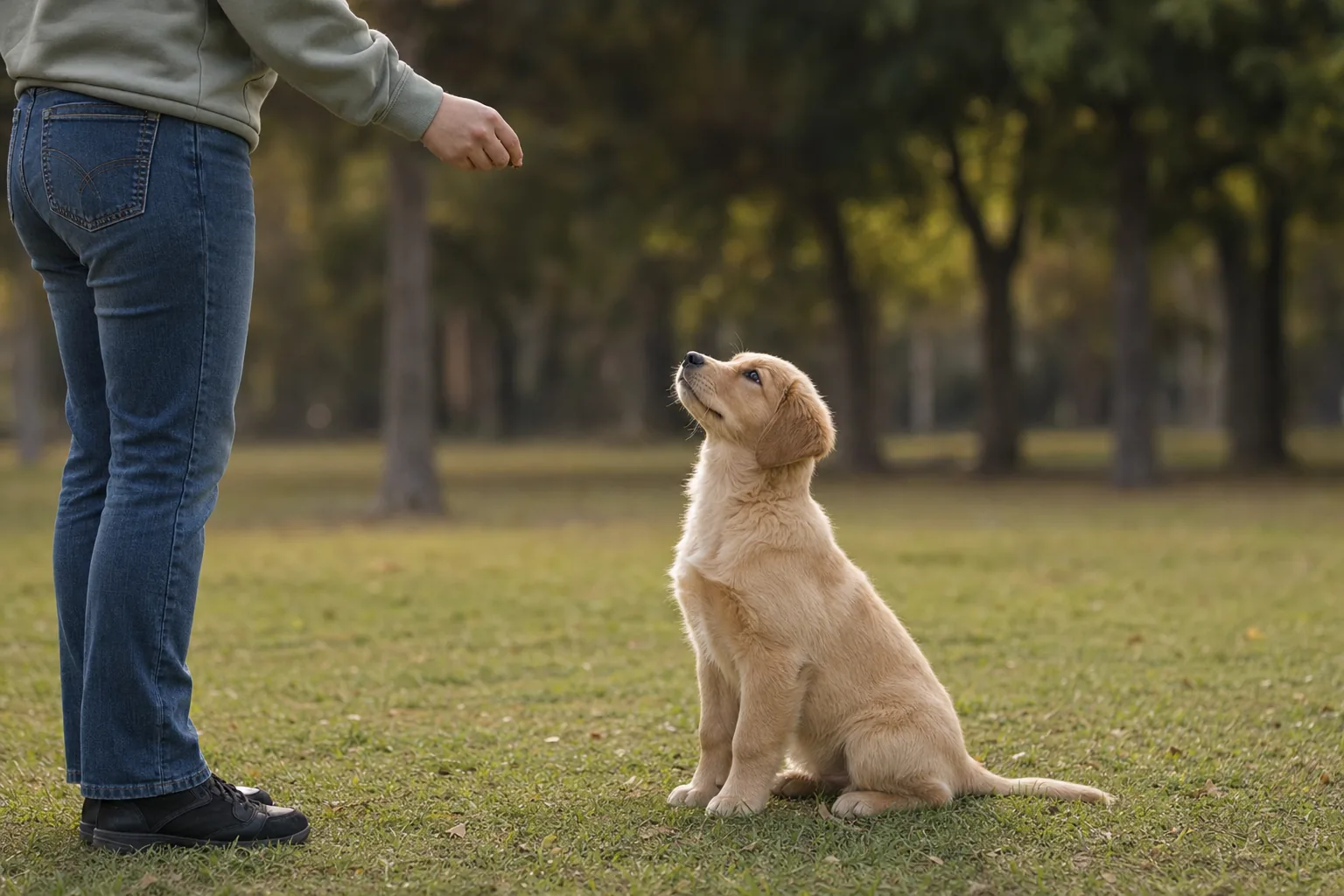
Your puppy is four and a half months old. This morning there was a tooth on the rug, about the size of a grain of rice and sharp as a needle, and this evening you caught him working on the table leg with a seriousness you had never seen in him. His gums are red, there is the odd spot of blood on his toys, and he mouths everything within reach, starting with your hands. He is teething. It is one of the most predictable stages in a dog's life: it runs for a few months and is over by about seven. Use it well and you come out the other side with a dog who lets you handle his mouth and knows what he is allowed to chew.
What to do while the new teeth come through
1. Give him things to chew, and more than one kind
He chews because his gums itch and because a puppy finds out about the world with his mouth. You will not stop that. What you can decide is what he chews. Keep three or four different kinds of toy handy and swap them round every day so he does not get bored:
- soft rubber toys sized for his mouth, stuffed with a little wet food and frozen;
- a wet cotton cloth, twisted and kept in the freezer, to rub on his gums or for him to chew while you sit with him;
- rope toys for games with you, never for chewing on his own, because the threads end up swallowed;
- edible puppy chews you can bend slightly with a finger or mark with a fingernail.
For hardness, use your thumbnail. If it leaves no mark, the thing is too hard for milk teeth and for the new teeth just breaking through.
2. Swap instead of scolding
You find him with your slipper, the chair leg or, worse, a cable. Do not snatch it. Put a chew or a tasty bit of food right by his nose and wait for him to drop the slipper. The moment he does, praise him warmly and hand over the toy. Then put the slipper somewhere he cannot reach. A puppy who has learnt that "give" means something good arriving will let go of things rather than charging round the house with them.
3. Puppy-proof the house for a few months
Lift or cover cables, put shoes away in a cupboard, and wrap the furniture legs you would hate to see chewed, or block them off with a pen. When you cannot keep an eye on him, he goes somewhere safe, a pen or an empty room, with his own chews. You only need the pen for these months, until teething is done.
4. Get him used to your hand in his mouth
There is no better time for it. One minute a day: lift his lip, look at his teeth, touch his gum with a finger, then give him a treat and tell him he is a good lad. Start with a single second and build up slowly. A dog who learnt this as a puppy lets the vet look him over and takes his tablets without a battle for the rest of his life.
5. Check his teeth once a week
Look hardest at the canines, the long teeth at the corners of the mouth. If an adult tooth has come up beside a milk tooth and the milk tooth is still there a week or two later, make a note and tell your vet. A photo helps a lot.
6. When he goes for your hands
His mouth is sorer now and busier, so he bites more. When he grabs your hand, stop the game for a second, take your hand away calmly, then give him the toy. If he is really wound up, give him a short spell in his pen with something to chew, no telling-off. We have a separate page on puppy biting.
The first week, if teething has just started
| Day |
What you do |
| 1 |
Tidy away cables and shoes. Pick 3 or 4 different chews. |
| 2 |
Put the wet cloth and a stuffed toy in the freezer. |
| 3 |
Start the lip lift, one minute a day, with a treat and praise. |
| 4–7 |
Practise the swap 3 or 4 times a day with things that do not matter, so it works when it does. First check of the canines. |
What happens to the teeth at each age
Young puppy (3–8 weeks). The milk teeth come through between 3 and 6 weeks: 28 of them, small and very sharp. With them he learns from his mother and littermates how hard he is allowed to bite. If you bring him home at 8 weeks, his milk teeth are already all in.
Puppy (3–7 months). At around 3 to 4 months the incisors, the little front teeth, start to fall out. Between 4 and 6 months it is the turn of the canines and the cheek teeth. Most of the time you never see them go: plenty of milk teeth are swallowed with his food and do him no harm at all. By 6 or 7 months he has all 42 adult teeth. Small breeds can be a bit later, and they are also the ones most likely to hang on to a forgotten milk tooth.
Adolescent (7–18 months). The teeth have changed but the urge to chew has not, because the jaw is still getting stronger, and lots of young dogs chew hard until they are about a year old. Keep going with suitable chews and the thumbnail test. This is the time to move from your finger to a dog toothbrush, a bit at a time.
Adult. This is where the puppy work pays off: he lets you handle his mouth and you can brush his teeth without a fuss. Tartar and gum disease are common in adult dogs, and regular brushing is the simplest way to prevent them.
Senior. The habit of looking in his mouth, kept up since puppyhood, lets you catch a loose tooth or a swollen gum early. An old dog who has had his mouth handled all his life gets through dental check-ups far more easily.
Mistakes we see a lot
Bones, antlers and hard hooves. They are among the commonest causes of broken teeth in dogs, and a tooth that has only just come through is more fragile than a mature one. Cooked bones splinter on top of that.
Pulling a wobbly tooth out yourself. The root can snap off and stay in the gum. Let it fall out on its own, and if it will not, the vet takes it out.
Tug with lots of jerking. Tug is a good game. During these months, though, keep it gentle, no yanking, and never lift the puppy off the ground by the toy.
Telling him off or punishing him for chewing. Yesterday he was given the old slipper, today you are shouting about the red shoe. He cannot see the difference, so all he learns is to chew when you are out of the room. Things he must not have live up high. Things he may have live down low, within reach.
Old children's toys or old slippers as chews. He cannot tell an old slipper from a new one.
Panicking at blood on a toy. A few drops when a tooth comes out are normal. Bleeding that does not stop, swelling, or a puppy who has gone off his food is another matter.
Forgetting to check the canines. A milk tooth left beside the adult one traps food and tartar and can push the new tooth out of position.
How long it lasts and how to tell it is going well
Start to finish, teething takes about three to four months: from the first incisors falling out at around 3 to 4 months to the last cheek teeth at around 6 to 7 months. The heaviest chewing is usually between 4 and 6 months.
Things are on track if, week by week, you notice that:
- he eats normally, even if he is sometimes slower or keener on soft food;
- you never see two teeth in the same spot for more than a week or two;
- the gums are red where teeth are coming through, but with no big swellings or pus;
- he chews his own toys, and your things less and less;
- he lets you lift his lip for a few seconds without wriggling;
- at around 7 months you can count 42 teeth, 20 on top and 22 below, or at least you no longer see small sharp teeth among the big ones.
When to see the vet and when to see a trainer
Tell your puppy's vet, at a routine visit or a vaccination appointment, if:
- a milk tooth is still sitting beside the adult one after a week or two, especially a canine; it gets removed, often under the same anaesthetic as neutering if the timing works;
- the lower canines are digging into the roof of his mouth or his bite looks crooked;
- you see a broken tooth with a pink or dark spot in the middle;
- he stops eating, has a swollen muzzle, bleeding that will not stop, or bad breath.
See a trainer if, after a few weeks of work, you find that:
- the biting of hands and clothes has not eased at all despite swaps and short breaks;
- he growls or bites properly when you take something out of his mouth;
- the chewing is wrecking the house even though he has plenty of toys and plenty of sleep.
For all three, a puppy class is the best place to start. You practise the swap, mouth handling and play with other puppies there, with someone beside you who can see straight away what is working and what is not.