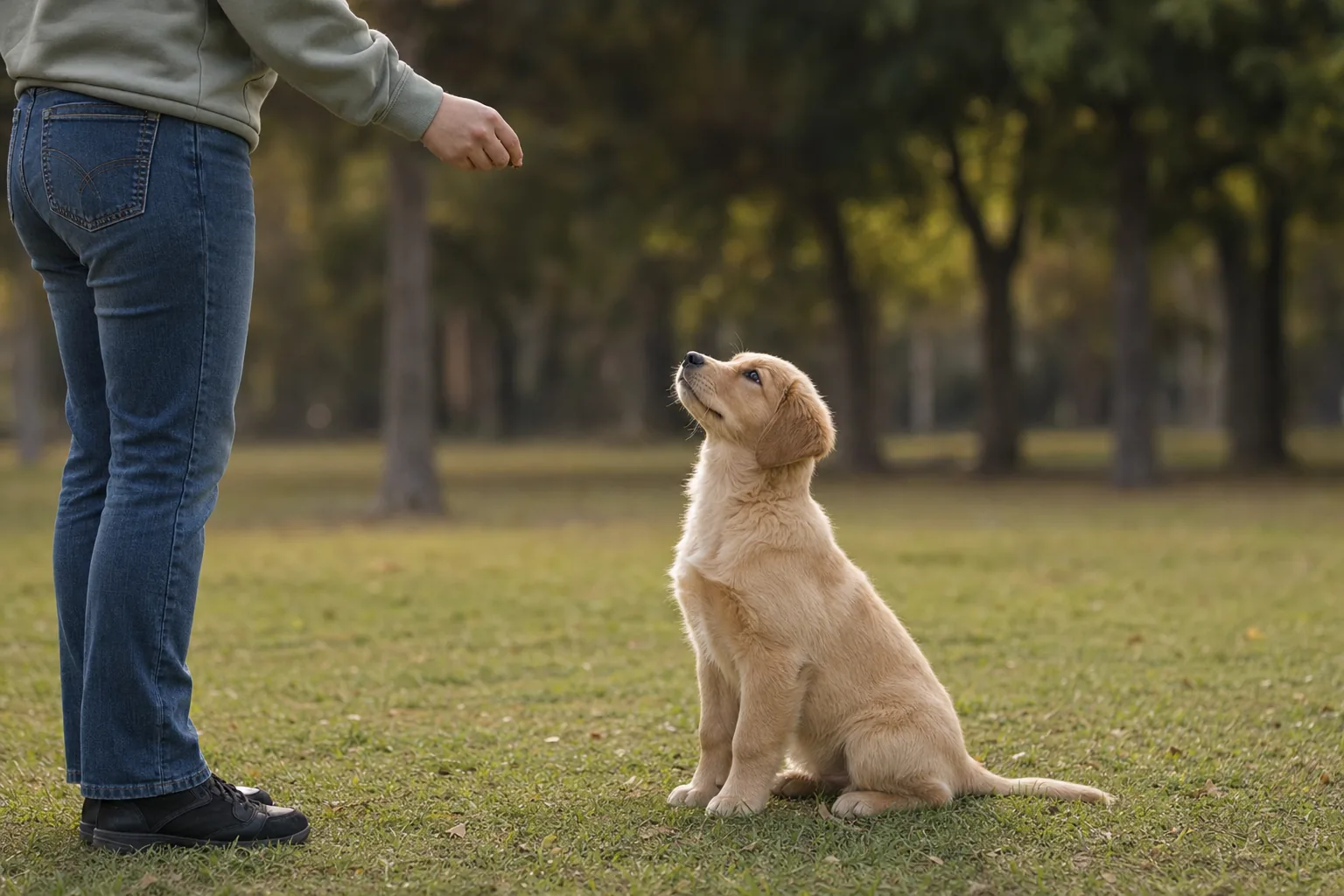
Your three-year-old wants to hug the dog every time she walks past him. The Labrador, who has put up with it for months, has started getting up and leaving the room. Or your seven-year-old wants to take him out on his own and teach him to sit. Or yesterday the dog growled at your child for the first time, and now you are wondering whether this is the start of something.
Dogs and children can grow up beautifully together. Plenty of adults remember their childhood dog as the best friend they ever had. That friendship does not happen by itself, though: the adults in the house build it, with a few clear rules. Below are the rules, what a child can do at each age and the signs a dog uses to tell you he has had enough.
House rules, one at a time
Research on dog bites in children has shown the same picture for years. Most bites come from a dog the child knows, very often the family's own dog, at home, on an ordinary day. The child hugs him, leans over him, touches him while he is asleep or eating, takes a toy off him. In small children the bite often lands on the face, because their face is at the height of the dog's muzzle. The rules below start from there.
1. The dog has a place of his own, where children do not go
A bed, an open crate or a corner in a quiet part of the house, where the dog can take himself off whenever he likes. The rule for children is short: when the dog is there, nobody bothers him. Not to stroke him, not to fetch a toy. If needed, a stair gate or a pen separates the spaces physically.
2. When the dog is left in peace
When he is asleep. When he is eating or chewing something. When he is ill, injured, old and tired. In any of these, even a very gentle dog may react.
3. The child learns how to stroke a dog
- Ask a grown-up before going over.
- Let the dog come to you. If he does not come, now is not the time.
- Stroke his chest or the side of his neck. Not his head, not his tail.
- No hugging or kissing, no climbing on him or pulling his ears.
- Stop after a few seconds and see whether he wants more. If he walks away, let him go.
Children remember rules better as a game: "we stroke him like a kitten", "the dog has his own bubble".
4. Supervising takes your eyes, not just your presence
An adult in the same room looking at their phone is not supervising. You are supervising when you are watching the dog and the child and can step in within two seconds. When you cannot (cooking, on the phone, changing a nappy), the dog and a small child are kept apart. Use a gate, a pen, the dog's open crate, or put him in another room with something good to chew. For both of them it is simply a break.
5. Learn to read the dog
Almost every dog tells you he has had enough long before he growls. The small signs are yawning when he is not tired, licking his lips, turning his head away, "whale eye" (the white of the eye showing as a half-moon), freezing, getting up and walking off. The big signs are a growl, a lifted lip, an air snap. When you see any of them, call the child to you, calmly (the child, not the dog), and give them both something else to do.
6. Never punish a growl
A dog who growls at a child is telling you clearly that something is not working. If you tell him off, he learns to stop warning. Separate them quietly, write down what happened just before and change the situation.
7. Play together, the right kind of play
Older children can play calm games with the dog. They hide treats and let him find them with his nose. They teach him simple tricks with treats and praise. They walk him with an adult also holding the lead. Games that wind him up (being chased by the child, tug with small children, rough-and-tumble) are best left out.
What a child can do, by age
Babies and toddlers up to 3
Never left alone with the dog. Not with the gentlest dog in the world, not for a minute. A toddler moves unpredictably, grabs, shrieks, falls on the dog and has his face at muzzle height. The dog only gets near the child while you are watching. We have a separate page on bringing a new baby home.
4 to 7
A child this age can learn the rules above but will not always stick to them, especially when excited. They can offer the dog a treat from a flat palm, throw his toy, help you fill his bowl, with you right there. The dog and the child are still never left alone together.
8 to 12
At this age a child can become a really good training partner. They teach the dog tricks with treats and praise, hide toys for him, come to a class with an adult. They can hold the lead on short, quiet walks with an adult alongside, especially with a big dog who pulls.
Teenagers
Teenagers can take on real responsibilities: walks, meals, nose games, even a dog sport. It is still worth reminding them that not every dog they meet in the street is like theirs.
The dog's age matters too
A puppy nips and jumps on children because that is how puppies play. He needs frequent breaks and an adult who stops the game before it gets wild. An older dog with aches or poor hearing puts up with much less and startles when touched unexpectedly. A rescue dog whose past you do not know needs a few weeks of watching before you form a view on him and children.
Mistakes we see a lot
"Ours doesn't bite"
Any dog can bite if he is frightened, in pain or pushed past what he can cope with. Many dogs who bite a child have never bitten anyone before.
Photos of a child hugging the dog
Online they look adorable. Look closely, though: in many of them the dog is licking his lips, looking away, showing the whites of his eyes. He is stressed.
The child who "helps with training"
A child who scolds the dog, yanks his collar or "puts him in his place" the way they saw on television is at risk of being bitten. Training is the adult's job. The child gets the fun part: treats, praise, games.
Punishing the growl
Punishment removes the warning and leaves the fear where it was. Next time the dog bites without warning.
The dog who is "made" to put up with it
A dog with nowhere to escape from the children ends up defending himself. His own place, respected by everyone in the house, is the simplest prevention there is.
Supervising "from the next room"
Most accidents happen in a few seconds, exactly when the adult is in another room.
How long it takes and how you know it is working
You set the rules up in a few days and keep them going for years. Children forget them and relearn them, so you will repeat them many times, and that is normal. Dogs usually relax within a week or two once they have their own place and the children have stopped disturbing them while they sleep or eat.
The good signs: the dog comes over to the children by himself and walks away calmly when he wants to. When the child approaches, you no longer see yawning, lip licking or freezing. Your child asks you before stroking him. There has been no more growling. And the nicest sign of all is the dog going to find his child for a game of hide and seek.
If the dog has bitten your child
Separate them at once, calmly. Wash the wound with soap and water and take your child to a doctor, even if it looks small, and without question if it is on the face. Check that the dog's rabies vaccination is up to date. Do not punish the dog.
In the same week, talk to your vet, because pain is a common cause, and to a behaviour professional. Until then the dog and the children are only together with a barrier between them. We have a separate page on what to do after a bite.
When to call a trainer
- the dog has growled at, snapped at or bitten a child, however lightly;
- the dog seems tense around the children or avoids them most of the time;
- you are expecting a baby and want to prepare the dog early;
- you are bringing a new dog or a puppy into a home with children and want to start off on the right foot;
- your child is scared of dogs and you want them to learn, safely, how to behave around them.
A trainer sees you all together, spots what slips past you in the rush of daily life and puts together a plan that fits your family. For a lot of children, an hour of scent games with the dog, guided by someone who knows what they are doing, is the start of a friendship that lasts the rest of their childhood.