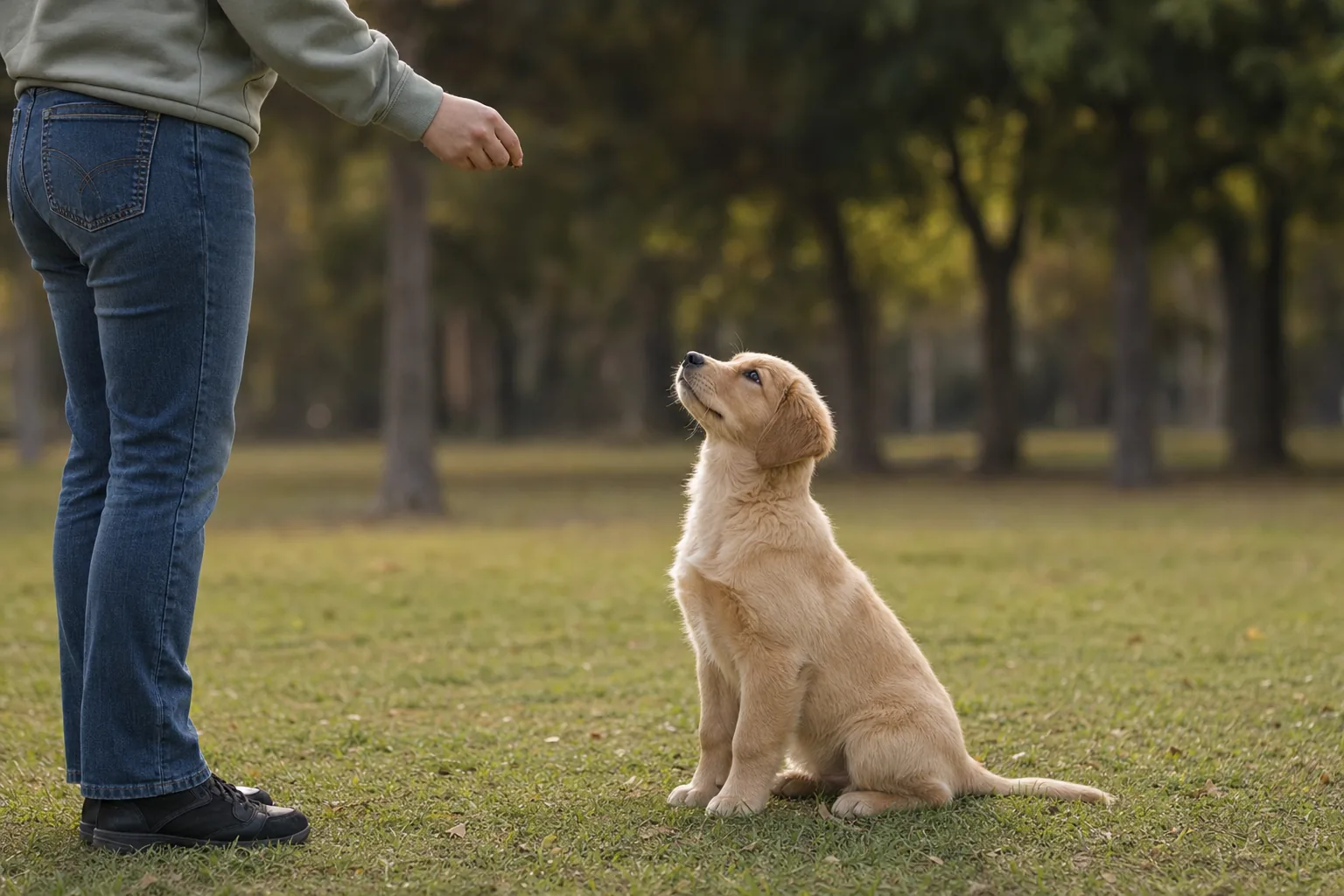
Four months to go. Your dog, a five-year-old crossbreed who sleeps in your bed and follows you from room to room, has no idea what is coming. Everyone has advice: "send him to live with your parents", "just let him sniff a blanket from the hospital", "dogs know, he will love the baby". The reality is a lot less dramatic. Most dogs adjust well to a baby on two conditions: the changes start before the birth, and the dog and the baby are never left alone together. What follows is the plan, month by month, from now until your child starts walking.
What to do, month by month
Three or four months before: new habits
Whatever is going to change after the birth, change it now, so the dog does not connect the change with the baby.
- Where he sleeps. If he will no longer be allowed on the bed or in the bedroom, move him now, to a good bed with a chew he only gets there.
- The nursery. Fit a baby gate to the nursery door. He learns that he goes in by invitation, or not at all. A gate beats a closed door, because he can still see and hear what is going on.
- Walks. If walks will happen at different times or with someone else after the birth, shift them now. Every so often make them shorter and make up for it with nose games indoors.
- Attention. Dogs who get attention whenever they ask for it struggle most when it dries up overnight. Start having long stretches at the desk or on the sofa without engaging with him, while he has something to chew next to you.
Two or three months before: what he needs to know
Five minutes a day, with good treats and lots of praise:
- Go to bed. Show him his bed, toss a treat onto it and praise him when he gets there. Then ask him to stay a few seconds, then a minute, then for as long as it takes you to change a doll on the changing table.
- "Leave it." Hold a treat in your closed fist; when he takes his nose off your hand, he gets one from the other hand. Then move on to things on the floor: socks, dummies, soft toys.
- Walking beside the pram. Go out with the empty pram, the dog on the other side, on a loose lead. If he pulls, stop. A month of practice now is much easier than the first outing with the baby in the pram and the dog yanking you sideways.
- Clumsy handling. Toddlers pull ears and tails. Without overdoing it, get him used to brief touches on his ears and paws, each followed by a tasty treat. This does not give your child permission to pull his ears; it gives the dog a safety margin for the day it happens.
A month before: sounds and smells
- Play recordings of a crying baby, turned right down at first, while he eats or plays. Turn the volume up from one day to the next, only as long as he stays relaxed.
- Start using the baby lotion and creams on your own hands.
- Set up the cot, the pram and the moving baby swing, and let him sniff them with you beside him.
- Sort out who will walk and feed him while you are in hospital, and do a trial run.
Coming home
- A blanket or vest the baby has worn, brought home ahead of time, is a gentle start but no miracle. Let him sniff it as much as he wants.
- On arrival, mum goes in first, alone, and greets the dog with her hands free; as far as he knows, she has been gone for days. Only once he has calmed down does the baby come in, in the other parent's arms.
- The first meeting: dog on a lead, you calm, baby in arms. He sniffs from half a metre away (not nose to nose) and gets praise and treats for calm curiosity. After a few seconds, call him away.
- In the first weeks, the good things in the dog's life happen while the baby is around: the walk, the game, the kind words. While the baby sleeps, do not ignore him completely, but do not smother him with attention to make up for it either. That way the baby comes to mean pleasant things.
The rule that is not up for discussion
The dog and the baby are never left together unsupervised. Not for ten seconds while you take a nappy to the bin. Not with "the gentlest dog in the world". Whenever you are not actively watching, the dog is in another room, behind the gate or in his crate. Most bites to young children come from the family dog, at home, during ordinary moments. Supervision means an adult who is awake, in the same room, eyes on both of them, or a barrier between them.
By age
The puppy or young dog (under 2). Lots of energy, and self-control still under construction. He jumps up, mouths in play, grabs things. You need more barriers (gates, a pen) and more daily exercise, even with a newborn in the house: a bored young dog is the hardest housemate of all. If you are thinking of getting a puppy during the pregnancy, wait. Two "babies" at once is too much for anyone.
The adolescent (6 to 18 months). The stage where he seems to have forgotten everything he knew. Practise the basics twice as often as feels necessary, and keep a lead on him indoors in the first weeks if you need to.
The adult dog. The easiest case, if he is healthy and sociable; the plan above is enough. Keep an eye on dogs who are very attached to one person. When that person is suddenly busy all the time, they can feel lost.
The senior dog. Many old dogs are in pain they do not show (joints, teeth, back), hear and see less well and startle more easily. A child who crawls up and grabs his tail may get a growl or worse. Book a vet check before the birth, give him a quiet spot the child can never reach, and let him sleep in peace.
And the child's age. A newborn sleeps and cries. The real risk starts when the baby begins to crawl and walk, around 6 to 12 months, and can reach the dog's food, toys and bed. That is when you check the gates and the rules again.
Common mistakes
"We let him lick the baby so they bond." A newborn's face has no business near a dog's mouth. Partly for hygiene, and partly because an excited dog can catch a little hand with his teeth without meaning to.
Cute photos of the baby propped on the dog. The dog in those photos is often stressed: head turned away, lip licking, whites of the eyes showing. No photo is worth that risk.
The dog pushed aside completely after the birth. Moved to the balcony, no walks, no attention. What he learns is that the baby brought all the bad things.
Telling him off for growling. A growl is a precious warning, his way of saying something is bothering him. Punish it and he learns to skip the warning. When he growls, add distance and work out what upset him.
His food and toys within the child's reach. Even the most tolerant dog may guard his bowl or chew from a child crawling straight at him. He eats separately, with the child in another room, and chews are only handed out when the child is not around.
"Dogs just know." They pick up on a lot, but they have no idea what a baby is, and its sounds, smells and movements are all new. Instinct does not stand in for months of preparation.
How long it takes and how to tell it is working
Ideally you start three or four months before the due date and carry on until the child is about two. It is going well if:
- he sleeps calmly in his new spot a few weeks before the birth;
- he goes to his bed and stays there when asked, even while you move around the room;
- the walk with the empty pram happens on a loose lead;
- the recorded crying gets one ear flicked up while he carries on eating;
- once you are home, he approaches the baby curious and relaxed, body soft, and moves away by himself;
- he eats and sleeps normally in the first weeks after the birth.
Be concerned, and get help, if you see something else: he stares stiffly at the baby, cannot settle when the baby cries, hides, goes off his food or growls when you come near with the baby.
When to call a trainer
Call a trainer or a behaviour specialist before the birth if:
- your dog has ever growled at, snapped at or bitten a person, especially a child;
- he guards his food, toys or resting place;
- he is frightened of children or reacts to them in the street;
- he fixates on small animals, cats or birds, and gets wound up by high-pitched sounds;
- he is very attached to one person and cannot cope with being apart.
The same goes after the birth if you see any of those signs. A specialist comes to your home, looks at how it is laid out and how everyone moves around in it, and gives you a plan that suits your dog. Call them early and the plan tends to be shorter and simpler.