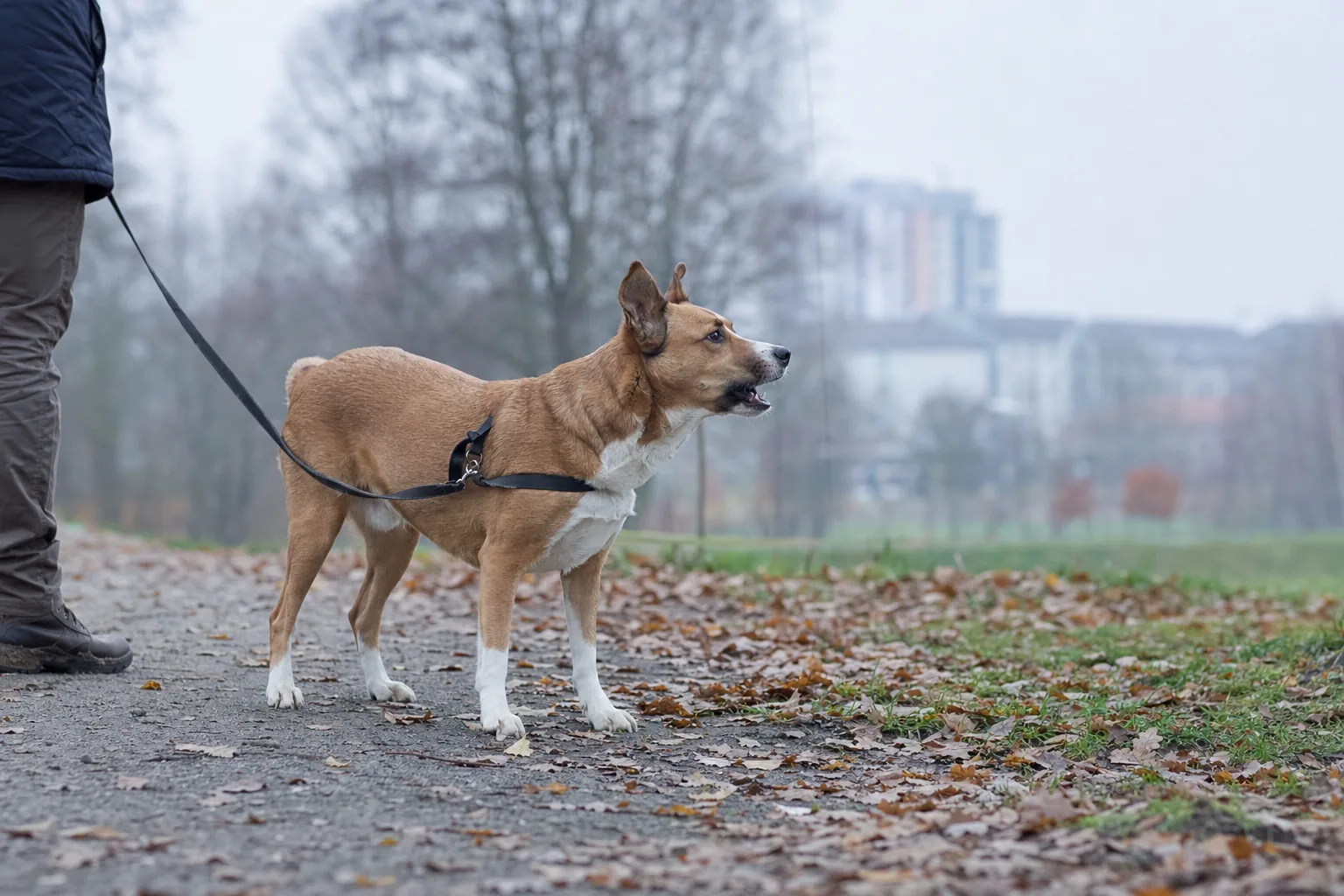
You open the cupboard for the hoover and the dog has already disappeared under the bed. Another dog does the exact opposite: barks, lunges at the brush, grabs the hose and follows you round the whole house. Then there is the new robot vacuum, and a seven-kilo dog curled up on the sofa with saucer eyes while it trundles round the living room. To us it's a cleaning appliance. The dog sees something else: a loud thing that moves unpredictably, roars at a pitch his ears pick up far more sharply than ours, and heads straight for his favourite spots. Fear of the vacuum is one of the most common fears in the home, and the good news is that it's also one of the easiest to work on, if you give it two or three weeks.
Why dogs fear the vacuum or bark at it
The noise
Dogs hear higher-pitched sounds than we do and pick them up from further away. The roar of a vacuum, with the thin whine of the motor on top, is close to painful for some dogs. A dog who is sensitive to noise in general (fireworks, thunder, slamming doors) is almost certainly scared of the vacuum as well.
The movement
The vacuum comes at the dog, backs off, comes at him again, and the brush "swallows" things off the floor. That isn't how objects behave. It looks alive and impossible to predict. A robot vacuum is stranger still, because it wanders about on its own with nobody pushing it.
He never got used to it
A puppy who didn't meet the vacuum in his first months, or met it for the first time running right next to him, can keep that fear for life. It's a common gap in dogs who came from a rescue or off the street.
A bad experience
The vacuum switched on next to him while he was asleep. The hose that hit him. Someone who "hoovered him for a laugh" to see what he'd do.
The urge to chase and catch
Herding breeds (Border Collies, shepherd dogs, Corgis) and some terriers don't run from the vacuum, they go for it: barking, biting the brush, trying to "round it up". It looks like play, or like aggression. Most of the time it's a mix of excitement and fear, a dog trying to get control of something that unsettles him.
What you do when the vacuum comes out
If you chase him off shouting, or shut him in another room in a hurry, the vacuum becomes the signal for one more unpleasant thing. Dogs connect these things quickly: the machine appears, something bad follows.
What doesn't work, even when it seems to
The most common idea is to hold him next to the running vacuum "so he gets used to it". Someone holds him, the vacuum runs, the dog freezes. He looks as if he has accepted it. In fact he's frozen with fear, and next time the fear is bigger.
Pointing the vacuum at him "so he sees it's nothing" doesn't help either. To him it's being chased, so he runs harder and barks more.
Telling him off for barking adds another reason to be wound up on top of the one he already has, at the exact moment the machine is on.
Then there's playing with the vacuum. Some people let the dog "fight" the brush because it looks funny. In herding dogs it becomes a habit that is hard to stop, and it sometimes moves on to the mop, the broom or the children's feet.
And swapping the big vacuum for a robot. For some dogs that works. For others the robot is even scarier, because it turns up out of nowhere and moves by itself.
Getting him used to the vacuum, step by step
In short: you get him used to it gradually, starting at a distance and volume where he is relaxed, and you link every appearance of the vacuum to something he really loves. Behaviour books call this desensitisation and counter-conditioning. In your house it means tasty treats, distance and patience.
1. No more frights, starting today
While you are working on the fear, he shouldn't have to go through it. When you vacuum, he is out on a walk with someone else, or in a room well away with the door shut, something good to chew and the radio on. Schedule the robot for when he is out on his walk. Every extra fright sets you back a few days.
2. The vacuum, switched off, becomes furniture
Take the vacuum out and leave it, switched off, in a corner of a room where the dog spends a lot of time. Every so often drop a few good treats on the floor next to it. He comes over if he wants to; don't call him and don't push him towards it. For a few days the vacuum is just an object that smells interesting and has good things lying next to it.
3. The vacuum moves, still switched off
Push it slowly round the room, switched off, at a distance from him. When he looks at it calmly, he gets a treat. If he gets up and leaves, let him go, and next time move more slowly or further away.
4. The sound, from a long way off
Someone else switches the vacuum on in a distant room with the door shut, while you sit with the dog at the other end of the house. The second the noise starts, the treats start raining down: one after another for as long as he can hear it. The vacuum stops, the treats stop. A few seconds at first, then up to a minute. He learns that the roar means something brilliant is coming.
Then the door opens, and the vacuum comes closer, a little at a time. At every step he must still be able to eat and to look at you. If he stops eating, hides or barks, you have gone too fast, so go back to the distance where he was still relaxed.
5. A place of his own while you vacuum
Once he can cope with the vacuum running in the same room at a distance, give him a fixed spot (a blanket, a bed) where he gets something to chew or a food-stuffed toy. You vacuum the other side of the room. His spot doesn't get vacuumed while he is on it.
6. If he attacks the vacuum
Same plan, with one difference: he needs a job that keeps him away from the brush. His blanket and a stuffed toy, for example, or treats hidden in another room for him to find. If he still goes for the vacuum, stop him without scolding (switch the machine off, take him calmly by the harness) and lead him back to his job. Indoors, a light lead clipped to the harness lets you stop him without grabbing his collar.
The first two weeks
| Days |
What you do |
| 1–14 |
Vacuum only when the dog is out, or shut in well away with something good to chew. |
| 1–3 |
The vacuum sits in the room switched off, with treats next to it. |
| 4–6 |
Move the vacuum slowly, switched off; a treat whenever he looks at it calmly. |
| 7–10 |
Switch it on in the furthest room; treats raining down while it runs. |
| 11–14 |
Door open, distance shrinking little by little; he stays on his spot with something to chew. |
With very frightened dogs a single stage can take a week. The dog sets the pace. The table is there so you don't skip steps.
When noise fear is a health issue
A dog who is suddenly scared of noises he used to ignore needs to see a vet. Pain, especially in the joints, back or neck, makes dogs more sensitive to loud sounds, and there is research linking musculoskeletal pain to noise fear that appears later in life. It works the other way round too: a dog who no longer seems to hear the vacuum may have a hearing problem.
Book in with your own vet before you start the plan if:
- the fear appeared suddenly in an adult dog, especially after 6–7 years of age;
- he is also scared of other new noises, limps, struggles to get up or no longer jumps on the sofa;
- he trembles, pants or hides at other times too, for no reason you can see.
How nose work helps
Treats scattered on the floor while the vacuum runs in the distance are already a small piece of nose work. A dog searching with his nose down is calmer than one standing and staring at the machine. Search games also build confidence: he finds out he can solve a problem on his own, and that helps with any fear. You can turn hoovering time into find-the-treats time in the bedroom. You do the living room, he has a job for his nose.
When to call in a professional
Ask a trainer for help in any of these situations:
- he is scared of lots of noises, not just the vacuum (fireworks, thunder, doors, cars);
- he trembles, drools, wets himself or can't settle for hours after the vacuum has stopped;
- he bites the vacuum, or has bitten someone who tried to stop him;
- after three weeks of work he still can't stay in the house with the vacuum running, even in the furthest room.
At an assessment session we see the dog in his own home and put together a plan with you for every noise that frightens him.
A behaviour that appears suddenly or changes for no apparent reason can have a medical cause. For full details, consult your dog's own veterinarian.