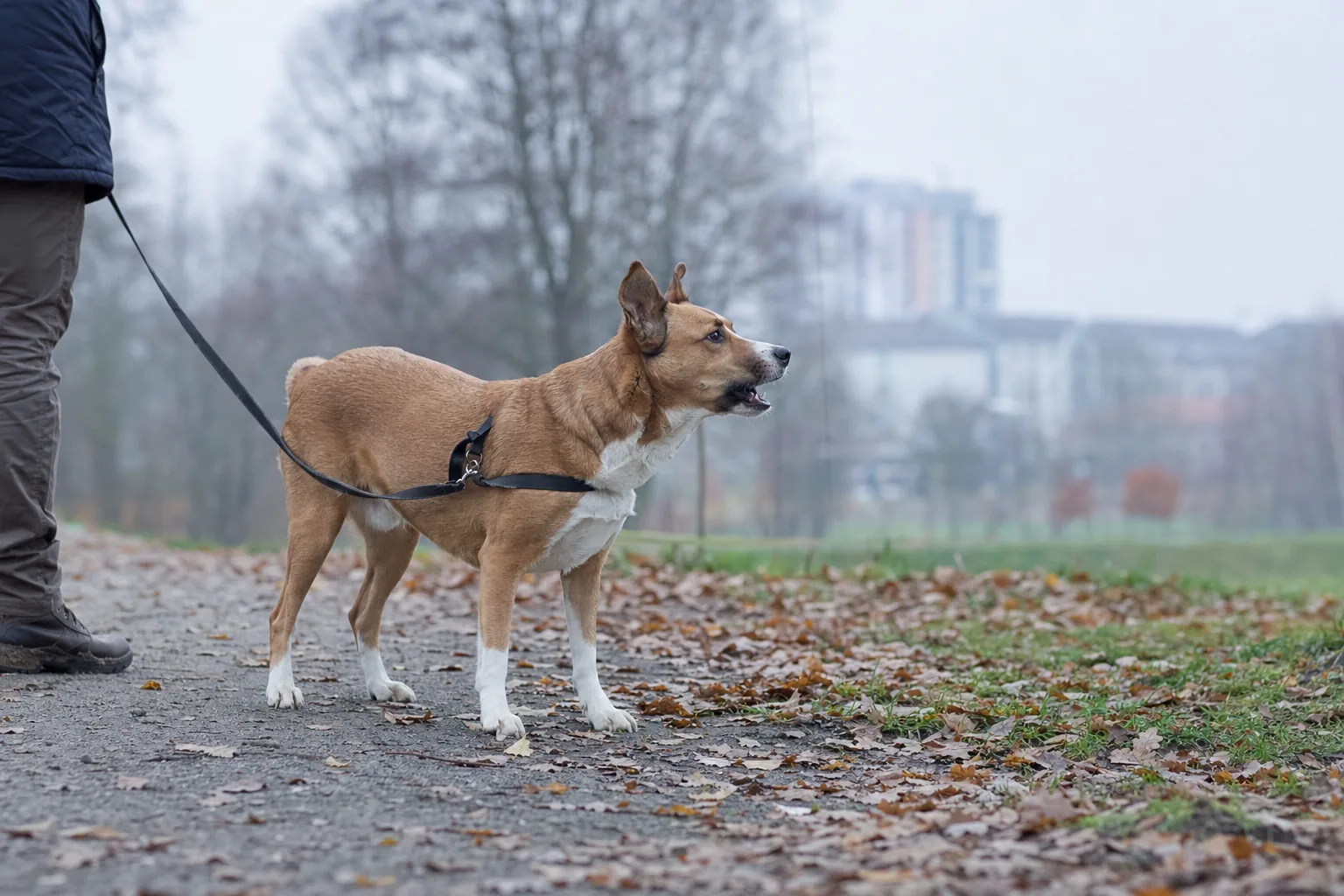
A Sunday evening on the sofa. Your partner reaches over to put an arm round you and, before it lands, the dog is already between you: nose in your lap, two barks, a paw on his sleeve. Or the less funny version: your new partner sits down on the sofa and the dog, who was asleep there, stands up stiffly and growls. At bedtime, when your partner goes to get in, the dog stares and does not move. Friends laugh and call him jealous. You start to wonder whether he is dangerous. A dog does not think like a jealous person, but what he feels is real, and it changes, once you have worked out what it is.
Why he does it
Research over the last few years has shown that dogs do have reactions that look like jealousy: they get agitated and try to step in when their person gives attention to someone else, especially another dog or a rival. That is as far as the science goes. In practice, the "jealous" label covers several different reasons with different plans, and you tell them apart by writing down three or four episodes: what the dog did and what his body looked like.
He wants in on the game. Two people holding each other and laughing looks, to a dog, like play. He jumps, gives short barks, wags widely, his body is loose. This is the most common case and the easiest to change.
He doesn't like what he sees. A tight hug can look, from where he stands, like a fight or like someone being pinned down. Sensitive dogs push in between you, lick their lips, put their ears back. They are not taking anything from anyone; they are trying to settle something that looks tense to them.
He's learnt that it works. Every time he jumped in, you laughed, picked him up, pulled him into the hug. As far as he is concerned, that is how it goes.
He's guarding a person or a place. This is the serious one. The dog treats his person, the sofa or the bed as something precious and defends it from the other person: stiff body, hard stare, a growl, sometimes a warning snap. It happens more in dogs with free access to the bed and sofa, and when the partner is new in his life.
Something has changed. A partner moving in, a new routine, fewer walks. The dog has lost something and reacts. One-person dogs, especially rescues, feel it more.
He's afraid of the partner. Of men, deep voices, tall people, the way this particular person moves. Barking and growling then mean "keep back", and the hug brings the very person he fears closer.
What doesn't work (and why it looks like it does)
Telling off and punishment. A dog scolded for growling at the partner learns that the partner means trouble. The growl may go; the fear stays, and the next signal may be the bite itself.
Forcing the friendship. The partner who picks him up, holds him, makes him sit alongside "so he sees I'm all right". For an insecure dog, that is the frightening part.
The bed and sofa left as they were. A dog who growls from the bed and stays on the bed rehearses guarding every single night.
Laughing and filming. Clips of dogs "splitting up" couples do well online. Every cheerful reaction tells the dog he got it right.
The partner ignoring him completely. Common advice. With a fearful dog it helps if the partner does not push, but a person who never brings anything good stays a stranger. Better that the partner becomes the source of good things, with no pressure attached.
The plan, step by step
1. Set the house up so he stops rehearsing
While you work on this, the dog no longer sleeps on the bed and, if he guards the sofa, stays off the sofa too. In return he gets a good bed of his own, in the bedroom or another room, as you prefer. If he is in the room with you in the evening and winds himself up, a baby gate across the door sorts it. For him it is a break from the situations that load him up.
2. The partner brings the good things
The partner takes over some of the day's best moments: putting the bowl down, tossing a treat as he walks past the dog, picking up the lead for the favourite walk, throwing the ball. No touching unless the dog comes over by himself, no leaning over him. The dog learns that the partner turning up means something nice.
3. A hug means something good for him
Before you hug, the dog gets a stuffed toy or a chew on his blanket. Short, quiet hugs, a few metres away from him, no laughing or squealing. When the two of you come together, he gets the best thing of his day on his blanket. Over time the hugs get longer and closer.
4. Teach him what to do instead
Practise "on your bed" (he goes to the blanket and lies down) and "sit" for attention, separately. When he sees you moving towards each other and chooses on his own to sit or go to his blanket, you both praise him warmly and he gets a treat. Calm brings attention; jumping brings nothing.
5. If he jumps in, you stop
He jumps between you during an exercise: you separate calmly, no telling off, and step a pace apart. He is not brought into the hug. Next time, start further away or keep it shorter.
What the first week looks like
| Day |
What you do |
| 1 |
A diary of 3–4 episodes: what he does, what his body looks like. The dog comes off the bed. |
| 1–7 |
The partner puts the food down and picks up the lead. Treats tossed in passing, no touching. |
| 2–4 |
"On your bed" practised a few times a day, no hugging. |
| 4–7 |
Hugs of 2–3 seconds, at a distance, with the stuffed toy on his blanket. |
| 7 |
Reread the diary. Still jumping? Growling? If the growling continues, read the section on professionals. |
When it's a medical problem
A dog who suddenly turns irritable, growls or pulls away from touch, especially past the age of 7 or 8, may be in pain (joints, back, teeth, ears) or may be losing sight or hearing, so that sudden movements startle him. Pain is one of the most common hidden causes of growling. If the change is sudden or comes with other signs (moving stiffly, sleeping restlessly, eating differently), see your own vet first.
How nose work helps
A simple game lifted from mantrailing works wonders here: the partner becomes the person to find. Someone holds the dog, the partner shows him a treat, walks off and hides behind a door or a tree. The dog is released to search, and when he finds the partner, the partner praises him cheerfully and gives him whatever he loves most. Dogs fall for this game quickly, and the person at the end of the search becomes the person with the best moments. At our training sessions we often watch the relationship between a dog and a person change after a few trails where that person was the target.
When to call a professional
- the dog has bitten or tried to bite the partner, however lightly;
- he growls, stiffens or stares at the partner on the bed, on the sofa or when the partner comes near you;
- the partner is afraid of the dog;
- a baby is on the way, or there are small children in the house;
- after three weeks of the plan, the diary shows no change.
An assessment with a reward-based behaviour professional starts from your dog, your home and your diary. The earlier you start, the easier it is, especially with a big change in the household coming up.
A behaviour that appears suddenly or changes for no apparent reason can have a medical cause. For full details, consult your dog's own veterinarian.