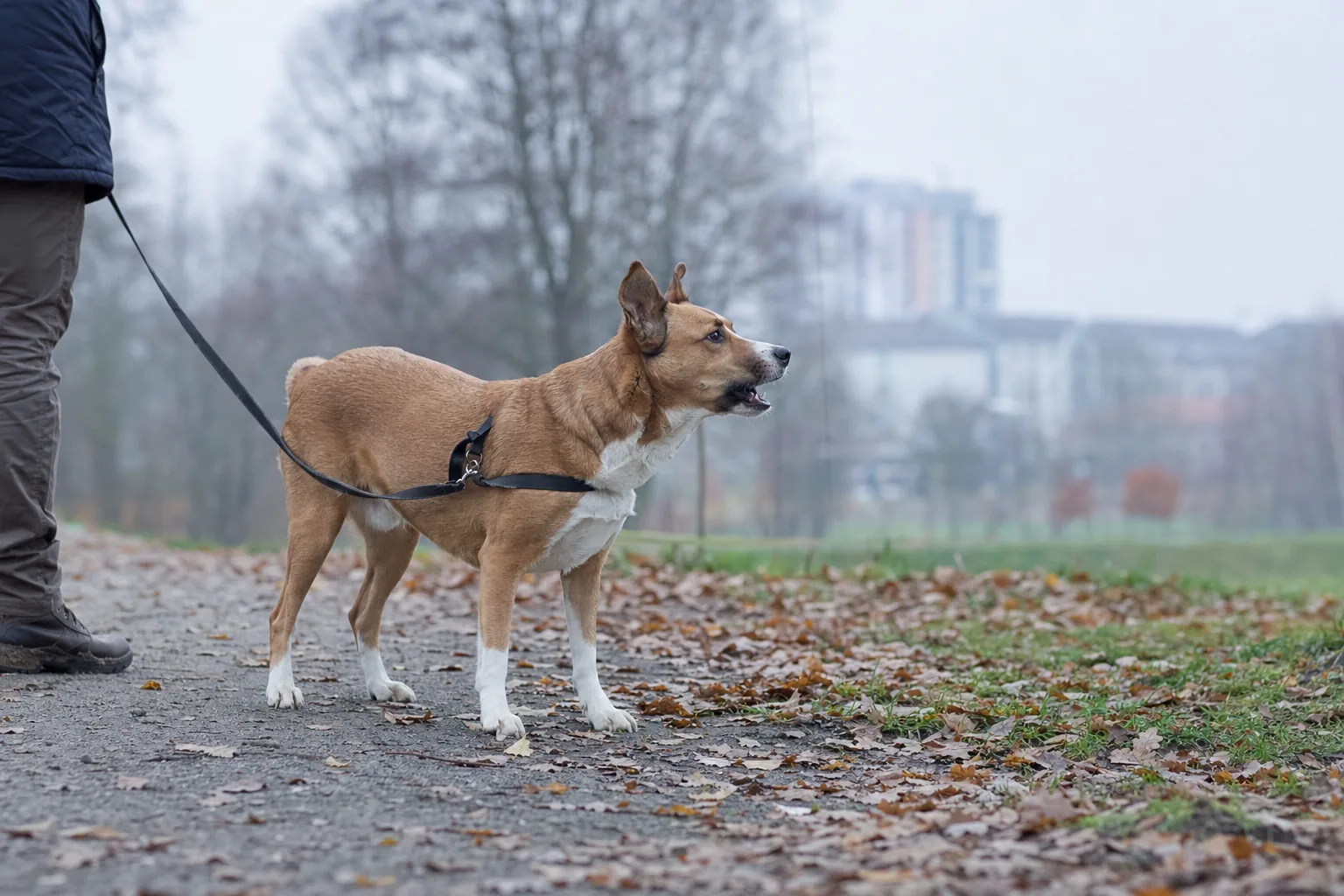
By October it is dark before six. The dog who used to be waiting at the door for his evening walk now stops on the doorstep and will not budge. Or he goes out, then two minutes later turns for home with his tail down, flinching at every shadow. Or, at night, he will not walk down the dark hallway to the kitchen and waits for you to put the light on. It looks like fear of the dark. More often he is scared of what happens in the dark, or his eyesight has started to go. This page helps you work out which it is, what the vet needs to rule out, and how to get him walking calmly in the evening again.
Why is my dog afraid of the dark?
Start with something most owners do not know: in dim light, dogs see far better than we do. Their eyes have more of the cells that work in low light, plus a mirror-like layer behind the retina that bounces light back through, so it gets used twice. That layer is why their eyes glow in car headlights. For a dog with healthy eyes, darkness itself is rarely the problem. There is nearly always something else going on.
Failing eyesight. Some eye diseases begin with night blindness: the dog sees well by day and poorly at dusk. The best known is an inherited disease of the retina found in a number of breeds, including poodles, cockers, Labradors and dachshunds. It usually shows first as hesitation in the dark, years before anything is noticeable in daylight. Cataracts and other eye problems can also leave older dogs unsure of themselves in low light.
An ageing brain. Older dogs with cognitive decline (vets compare it to dementia in people) often get unsettled in the evening and at night. They wander round the house, get stuck in corners, and are startled by places they have known for years. It usually turns up after 9 or 10 years of age, along with other changes: sleeping in the day and awake at night, accidents indoors, not recognising people.
Evening noise. In autumn and winter, evenings bring bangers and fireworks, dogs barking behind garden fences, headlights in his eyes and wheelie bins being slammed. One fright from a banger in the dark is enough for him to link darkness with the bang, and every evening walk becomes a wait for the next one.
A bad experience. Another dog went for him one evening, he fell into a hole he could not see, a cat shot out of a hedge right beside him. Once is enough.
Shadows and shapes. Someone in a hood, shadows shifting under street lamps, objects with a different outline after dark. Generally nervous dogs, especially those who met little of the world in their first months, react more strongly to anything dim light makes look odd.
What you are doing. Without noticing, you walk faster in the evening, you tense up and you shorten the lead. He feels that tension down the lead very clearly.
What does not work (even when it seems to)
Dragging him along. He comes, because he has no choice, but the fear does not go down. It goes up, because now he is afraid of the dark and of the lead. Some dogs back out of the harness and bolt, and a dog loose at night is the hardest of all to find.
Taking him somewhere darker and noisier "to get used to it". A dog thrown in at the deep end with something that frightens him does not get used to it. He gets more sensitive.
Telling him off for not wanting to go out. That hands him one more reason to worry, right when he was already tense.
Stopping evening walks altogether and letting him toilet indoors or on the balcony. Easier for now. Over time the evening becomes a no-go zone and the fear sets in.
Writing him off as fussy without having his eyes checked. In a middle-aged or older dog, new hesitation in the dark is a medical sign until proven otherwise.
The plan, step by step
1. Eyes first
Book him in with your own vet, especially if the hesitation appeared out of nowhere in a dog who used to go out in the evening without a second thought. Tell the vet exactly what you have seen: whether it is only in the dark, indoors as well or only outside, whether he bumps into things, whether he stops at stairs. The medical side is covered in more detail below.
2. Make evenings easier
- More light. Night lights in the hallway, the kitchen and next to his bed. When you get back from the walk, the house lights are already on.
- The right harness and lead. A well-fitted harness he cannot slip out of, with the lead clipped to it. Something reflective or lit on the harness or collar, so you can see him and drivers can see you both.
- The route. For a few weeks, evening walks go only along well-lit, quiet streets, on short routes he knows. Let him sniff as much as he likes; sniffing settles him.
- The time. In autumn, where you can, move the long walk to before sunset and keep only the short one for the evening.
3. Small steps
- Start on the doorstep with the light on. Stand there with him, give him a few tasty treats and let him look and sniff. If he relaxes, take a few steps and come back. Always head home while he is still calm.
- Add a few metres an evening. A few metres, not a whole neighbourhood.
- If he stops and does not want to go on, do not drag him. Wait a few seconds beside him, talk to him calmly, then turn for home. Next day, start from half that distance.
- Fill his evenings with good things: treats scattered in the grass under a street lamp for him to sniff out, a calm dog friend to walk with, his favourite dinner when you get back.
4. If his sight is poor
If the vet confirms his night vision is going, the plan changes. Do not move the furniture around, keep walkways clear and stick to routes he knows. Tell him what is coming with simple words ("step", "careful", "stop"), practised in daylight first. Dogs cope remarkably well with failing sight, especially when their nose and ears are good and the person beside them does things the same way every day.
The first week
| Day |
What you do |
| 1 |
Book the vet. Note how he reacts: where, what time, what noises there were. |
| 1–3 |
Night lights in the house. A well-fitted harness and something reflective. |
| 2–7 |
Long walk before sunset. In the evening, only short outings on lit streets. |
| 3–7 |
The doorstep exercise: a few minutes, tasty treats, a few steps, home while he is calm. |
| 7 |
Compare: how far he goes in the evening now and how quickly he settles. |
When it is a medical problem
Get him seen by the vet before you start on any plan if you recognise any of the following:
- hesitation in the dark has appeared in a dog who used to go out in the evening without trouble;
- he bumps into furniture or doors in low light, misses the ball in the evening, or takes stairs slowly;
- his eyes look different: large pupils in the light, a bluish or white patch in the eye, red eyes, watering;
- he is old and at night wanders round the house, gets stuck in corners, or no longer sleeps as he did;
- fear at night comes with panting, restlessness and being unable to settle (pain also ruins nights).
The vet will examine his eyes, may check his reflexes and how his pupils respond to light and, if needed, refer you to a veterinary ophthalmologist who can examine the retina. For the inherited retinal disease, there are genetic tests in many breeds.
When to call a specialist
- after three or four weeks of small steps, with his eyes checked and healthy, the fear is not easing;
- in the evening he panics: trembles, tries to get out of the harness, bolts, stops eating;
- fear of the dark comes together with fear of noises, fireworks or people, and seems to be growing;
- he has already run off once in the evening;
- he is old, and his restlessness at night means neither of you sleeps.
A behaviour specialist builds a plan with you that suits your dog, still in small steps, and works alongside your vet when the fear is severe or tied to age. For some dogs, anxiety medication prescribed by the vet is what makes the plan possible.
A behaviour that appears suddenly or changes for no apparent reason can have a medical cause. For full details, consult your dog's own veterinarian.