
Trail Journal Case 116
The stripe on the oar blade
At what time and from where did the call with the note “Diagonal stripe” come?
How the search began
What happened?
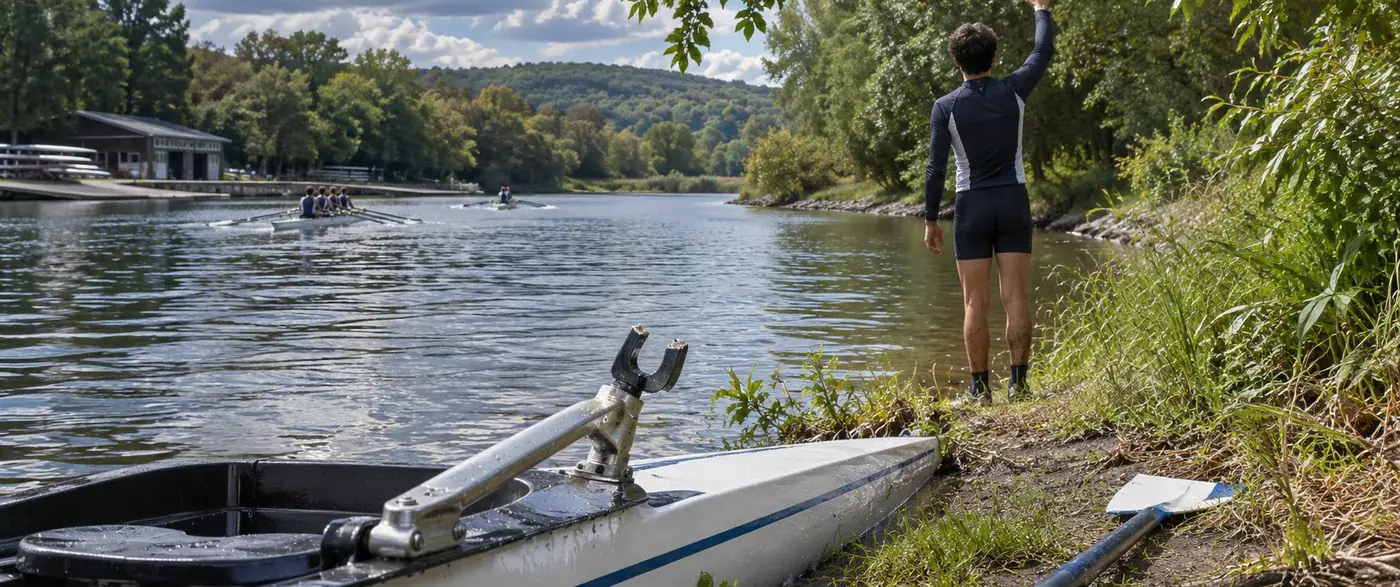
A junior from the rowing club comes ashore after breaking an oarlock. From the other boats, his teammates see him raise a hand to show them he has put his feet on land. One also remembers the dry crack made by the broken part. But the bank curves between that spot and the club pontoon. After the first few boat lengths, even if they turn round they can no longer see him.
His teammates reach the landing stage before him and the coach asks for help. Rescuers check the bank on foot, while the crew on the water listen to the messages. The boy's oar blade has a white stripe, drawn diagonally by himself.
The coach knows exactly how the white stripe got onto the blade. The boy had painted it at the start of the season so he could find his oar quickly in the pile by the shed. Today the same stripe can show the crew on the water where to approach those who are searching on foot.
You have three calls. Each has a signature, a landmark and a note. Each value appears only once. The times are those of the calls. “Immediately before” means that no other call came in between the two. At what time and from where did the call with the note “Diagonal stripe” come?
- Name · Adina, Paul, Sabina
- Landmark · Stepped Bank, Willow Threshold, Club Ramp
- Note · Yellow circle, Diagonal stripe, Black tip
- Time · 11:12, 11:19, 11:26
Search log
Field clues
I need a hint
Start with clue 4. The call from “Stepped Bank” was logged at 11:26.
One more hint
Combine clues 1 and 5. Together they give you one more pairing. Paul called in from “Stepped Bank”.
Workbook
Deduction grid
The grid is optional. You can use it to organise your notes and see which options you have ruled out. If you already have the answer, go straight to the final report.
Pick the cell where the two values you want to compare meet.
How to play: the basics and a worked example
What do I have to do in a case?
- Read the story and the question in the final report: At what time and from where did the call with the note “Diagonal stripe” come? That tells you what you have to reconstruct.
- Take the clues one at a time. Look for the two items each sentence links and note in the grid what you have learned. Then tick the clue so you remember you have used it. You can reread it at any time.
- If two clues share an item, follow it through both pairings. When you get stuck, you can open “I need a hint”, then “One more hint”.
- When you have a theory, fill in the two fields of the final report. You can send the report even if you left the grid empty. Then press “Check the report”. If the answer doesn't match, reread the clues and try again. Once it is confirmed, read the explanation in “The log, reconstructed”, shown below the report.
How do I correct a mark?
Tap the same cell to go through the three states, in order. You start from a dot. One tap puts ×, another puts ✓, and a third brings the dot back. So from ✓, a single tap clears the mark. The other cells only change when you tap them yourself.
How do I read the big grid in a case?
Above the columns you will see categories such as “Landmark” and “Note”. The rows are on the left. Follow the name on the row across to the column you are interested in and read the pairing as a question. A dot means you haven't noted the answer yet.
The one-match rule applies within each group of columns. After a ✓ you can put × in the other cells on the row and the column of the same group. In another group, the same row can have one more ✓.
Further down, the rows compare the remaining categories with each other. The hatched areas show pairings already covered elsewhere in the table. On a phone, swipe the table sideways to see the next group.
The example below is a made-up case with two dogs, Luna and Nori, who ended up in different places. The first clue says: “Luna did not finish the trail at the jetty.” Luna gets × under Jetty, so the greenhouse is all that is left for her and she gets ✓ there. The second clue says: “The team that reached the greenhouse used the bandana.”
| Reference | Place | Article | ||
|---|---|---|---|---|
| Jetty | Greenhouse | Bandana | Scarf | |
| Luna | ruled out | confirmed | confirmed | unknown |
| Nori | unknown | unknown | unknown | unknown |
| Jetty | Unused group of cells | unknown | unknown | |
| Greenhouse | confirmed | unknown | ||
On the “Greenhouse” row, the ✓ under “Bandana” comes straight from the clue. On the “Luna” row, the ✓ under “Bandana” is your own conclusion: Luna reached the greenhouse, and the team at the greenhouse used the bandana. The two ticks on Luna's row are in different groups.
Swipe the table to the left to see all the columns.
| Sheet | Landmark | Note | Time | ||||||
|---|---|---|---|---|---|---|---|---|---|
Final report
At what time and from where did the call with the note “Diagonal stripe” come?
The log, reconstructed
A patrol reaches the blade and sees the junior holding the boat by a ring set in the stone. At the club, the coach lets him tell his story before asking him about the repair.
| Name | Landmark | Note | Time |
|---|---|---|---|
| Adina | Club Ramp | Diagonal stripe | 11:12 |
| Sabina | Willow Threshold | Yellow circle | 11:19 |
| Paul | Stepped Bank | Black tip | 11:26 |
Solve another case
More cases of the same level from the collection.
-
 Case 117
Solved
The map stitched back to front
On the graduates' hike, the school librarian sets off with the slow group and never reaches the rest stop.
-
 Case 118
Solved
The carriage with a stove
At the railway museum, Lari splits from his class to look for the carriage his grandfather told him about.
-
 Case 119
Solved
The window on the dyke
A painter was sitting by the water when the storm began.