
Trail Journal Case 117
The map stitched back to front
Who reported the note “North stitched backwards”, and from which landmark?
How the search began
What happened?
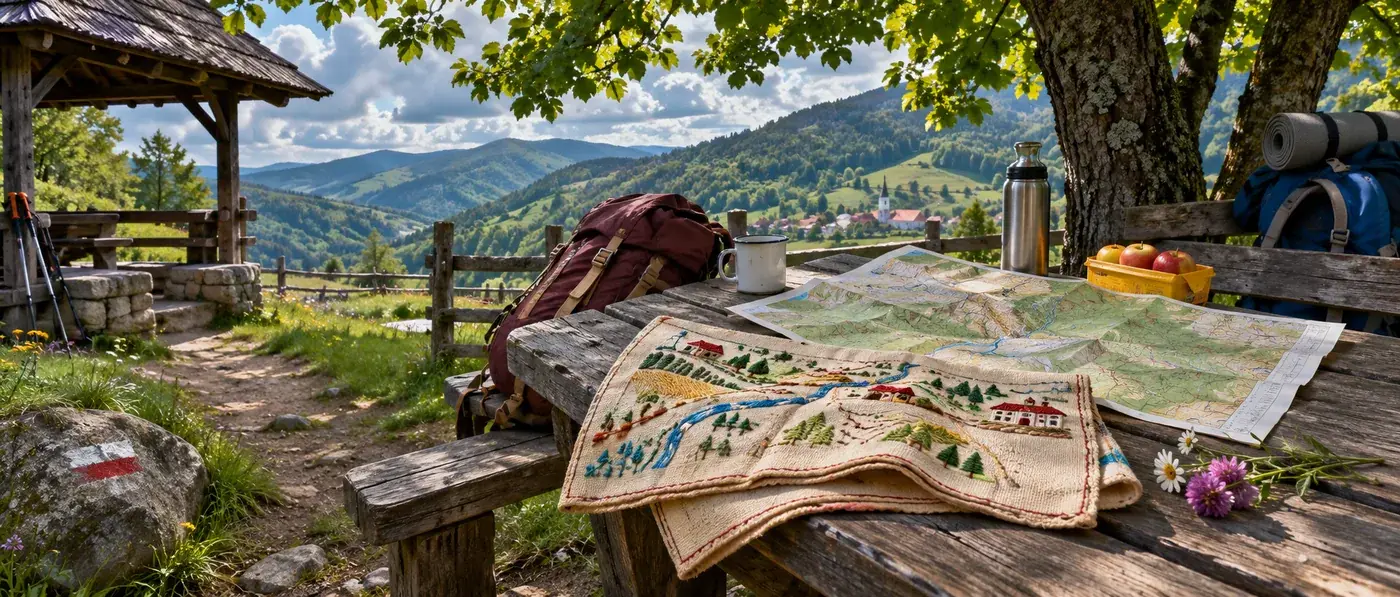
On the graduates' hike, the school librarian sets off with the slow group and never reaches the rest stop. She had last been seen putting into her rucksack the cloth map embroidered by the pupils. It was the gift from the final class. Each had stitched a piece of the road to school and, seen up close, one pupil's lane was almost as wide as a valley. The librarian said that was exactly why she liked it: by the width of the stitching she remembered who had held the needle. At the rest stop, the former pupils spread an ordinary map on the table and try to remember how far they had gone with her.
The family brings the mantrailing team one of her jumpers. Three patrols report the signs they met on the paths. The map is recognisable by its north stitched backwards.
One of those who worked on the map admits the mistake without waiting to be asked. When the embroidery was turned the right way round, the letter was already stitched backwards and nobody wanted to unpick it. So the patrols have a precise sign by which to tell the cloth from the other markers along the route.
You have three calls. Each has a signature, a landmark and a note. Each value appears only once. The times are those of the calls. “Immediately before” means that no other call came in between the two. Who reported the note “North stitched backwards”, and from which landmark?
- Name · Dan, Dinu, Dora
- Landmark · Fork in the Path, Lower Spring, Beech Bridge
- Note · Marker post with arrow, Paint mark, North stitched backwards
- Time · 08:04, 08:11, 08:18
Search log
Field clues
I need a hint
Start with clue 2. The 08:04 sheet carries the note “Paint mark”.
One more hint
Combine clues 1 and 5. Together they give you one more pairing. The call from “Beech Bridge” was logged at 08:18.
Workbook
Deduction grid
The grid is optional. You can use it to organise your notes and see which options you have ruled out. If you already have the answer, go straight to the final report.
Pick the cell where the two values you want to compare meet.
How to play: the basics and a worked example
What do I have to do in a case?
- Read the story and the question in the final report: Who reported the note “North stitched backwards”, and from which landmark? That tells you what you have to reconstruct.
- Take the clues one at a time. Look for the two items each sentence links and note in the grid what you have learned. Then tick the clue so you remember you have used it. You can reread it at any time.
- If two clues share an item, follow it through both pairings. When you get stuck, you can open “I need a hint”, then “One more hint”.
- When you have a theory, fill in the two fields of the final report. You can send the report even if you left the grid empty. Then press “Check the report”. If the answer doesn't match, reread the clues and try again. Once it is confirmed, read the explanation in “The log, reconstructed”, shown below the report.
How do I correct a mark?
Tap the same cell to go through the three states, in order. You start from a dot. One tap puts ×, another puts ✓, and a third brings the dot back. So from ✓, a single tap clears the mark. The other cells only change when you tap them yourself.
How do I read the big grid in a case?
Above the columns you will see categories such as “Landmark” and “Note”. The rows are on the left. Follow the name on the row across to the column you are interested in and read the pairing as a question. A dot means you haven't noted the answer yet.
The one-match rule applies within each group of columns. After a ✓ you can put × in the other cells on the row and the column of the same group. In another group, the same row can have one more ✓.
Further down, the rows compare the remaining categories with each other. The hatched areas show pairings already covered elsewhere in the table. On a phone, swipe the table sideways to see the next group.
The example below is a made-up case with two dogs, Luna and Nori, who ended up in different places. The first clue says: “Luna did not finish the trail at the jetty.” Luna gets × under Jetty, so the greenhouse is all that is left for her and she gets ✓ there. The second clue says: “The team that reached the greenhouse used the bandana.”
| Reference | Place | Article | ||
|---|---|---|---|---|
| Jetty | Greenhouse | Bandana | Scarf | |
| Luna | ruled out | confirmed | confirmed | unknown |
| Nori | unknown | unknown | unknown | unknown |
| Jetty | Unused group of cells | unknown | unknown | |
| Greenhouse | confirmed | unknown | ||
On the “Greenhouse” row, the ✓ under “Bandana” comes straight from the clue. On the “Luna” row, the ✓ under “Bandana” is your own conclusion: Luna reached the greenhouse, and the team at the greenhouse used the bandana. The two ticks on Luna's row are in different groups.
Swipe the table to the left to see all the columns.
| Sheet | Landmark | Note | Time | ||||||
|---|---|---|---|---|---|---|---|---|---|
Final report
Who reported the note “North stitched backwards”, and from which landmark?
The log, reconstructed
The dog goes past the place where the map was found and finds the librarian by a spring. She was resting her ankle and asks first about what the children had made for her.
| Name | Landmark | Note | Time |
|---|---|---|---|
| Dan | Lower Spring | Paint mark | 08:04 |
| Dinu | Fork in the Path | North stitched backwards | 08:11 |
| Dora | Beech Bridge | Marker post with arrow | 08:18 |
Solve another case
More cases of the same level from the collection.
-
 Case 118
Solved
The carriage with a stove
At the railway museum, Lari splits from his class to look for the carriage his grandfather told him about.
-
 Case 119
Solved
The window on the dyke
A painter was sitting by the water when the storm began.
-
 Case 120
Solved
The song of the accordions
At a village wedding, the oldest folk musician goes out to tune his instrument.