Trail Journal Case 071
The silver blanket
Who saw the blanket, and beside which landmark?
The real case · New Zealand Police
In the Kaweka Range, rescuers found a hunter at the camp he had made beside the river. He was waiting by the fire, wrapped in a survival blanket.
How the search began
What happened?
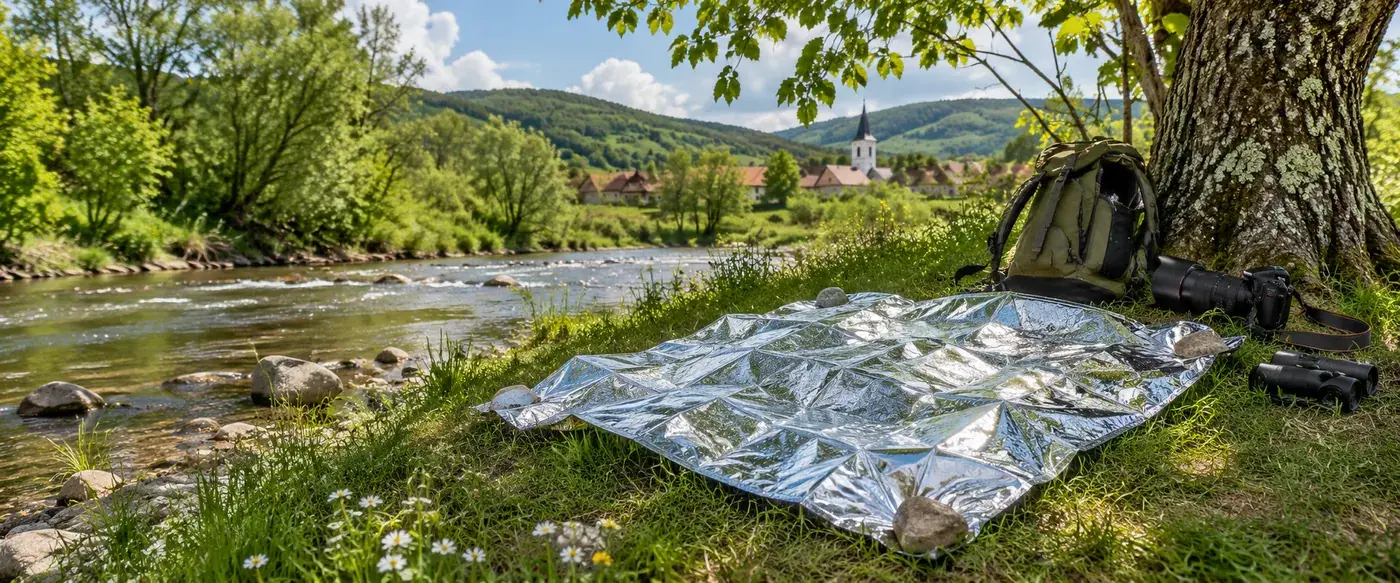
After the village fair, Sandu went off to photograph birds by the river. His daughter had helped him fold the blanket until it fitted into the narrow pocket of his rucksack. It rustled so loudly that they had both laughed at the idea that it might frighten the very birds he was going to photograph. Now she also remembers how it looked unfolded, which she can describe more easily than the shade of his field jacket.
In the evening, the family reports that he hasn't come back. The forester calls out the search teams and tells them that Sandu has a silver blanket in his rucksack. In the morning, three observers each report a glint on the bank.
At the start of the day, many things shine on the wet bank. The observers change the angle they look from and describe separately the surface the sun falls on. One of the descriptions is worth taking back to the family, because it shows where Sandu might have stopped for the night. Sandu's daughter angles the corner of a similar blanket towards the light, to show those at base the reflection.
You have three field sheets. Each landmark and each note appears on one sheet only. Who saw the blanket, and beside which landmark?
- Name · Petra, Silviu, Vivi
- Landmark · Alder Bend, White Bank, Lower Shingle
- Note · Silver blanket, Shiny glass, Corrugated tin
Search log
Field clues
I need a hint
Start with the one certain pairing, “Petra” and “Corrugated tin”.
One more hint
Once you have paired them, rule out “Corrugated tin” for the other two values in the “Name” category. Each value is used only once.
Workbook
Deduction grid
The grid is optional. You can use it to organise your notes and see which options you have ruled out. If you already have the answer, go straight to the final report.
Pick the cell where the two values you want to compare meet.
How to play: the basics and a worked example
What do I have to do in a case?
- Read the story and the question in the final report: Who saw the blanket, and beside which landmark? That tells you what you have to reconstruct.
- Take the clues one at a time. Look for the two items each sentence links and note in the grid what you have learned. Then tick the clue so you remember you have used it. You can reread it at any time.
- If two clues share an item, follow it through both pairings. When you get stuck, you can open “I need a hint”, then “One more hint”.
- When you have a theory, fill in the two fields of the final report. You can send the report even if you left the grid empty. Then press “Check the report”. If the answer doesn't match, reread the clues and try again. Once it is confirmed, read the explanation in “The log, reconstructed”, shown below the report.
How do I correct a mark?
Tap the same cell to go through the three states, in order. You start from a dot. One tap puts ×, another puts ✓, and a third brings the dot back. So from ✓, a single tap clears the mark. The other cells only change when you tap them yourself.
How do I read the big grid in a case?
Above the columns you will see categories such as “Landmark” and “Note”. The rows are on the left. Follow the name on the row across to the column you are interested in and read the pairing as a question. A dot means you haven't noted the answer yet.
The one-match rule applies within each group of columns. After a ✓ you can put × in the other cells on the row and the column of the same group. In another group, the same row can have one more ✓.
Further down, the rows compare the remaining categories with each other. The hatched areas show pairings already covered elsewhere in the table. On a phone, swipe the table sideways to see the next group.
The example below is a made-up case with two dogs, Luna and Nori, who ended up in different places. The first clue says: “Luna did not finish the trail at the jetty.” Luna gets × under Jetty, so the greenhouse is all that is left for her and she gets ✓ there. The second clue says: “The team that reached the greenhouse used the bandana.”
| Reference | Place | Article | ||
|---|---|---|---|---|
| Jetty | Greenhouse | Bandana | Scarf | |
| Luna | ruled out | confirmed | confirmed | unknown |
| Nori | unknown | unknown | unknown | unknown |
| Jetty | Unused group of cells | unknown | unknown | |
| Greenhouse | confirmed | unknown | ||
On the “Greenhouse” row, the ✓ under “Bandana” comes straight from the clue. On the “Luna” row, the ✓ under “Bandana” is your own conclusion: Luna reached the greenhouse, and the team at the greenhouse used the bandana. The two ticks on Luna's row are in different groups.
Swipe the table to the left to see all the columns.
| Sheet | Landmark | Note | ||||
|---|---|---|---|---|---|---|
Final report
Who saw the blanket, and beside which landmark?
The log, reconstructed
The team reaches the blanket spread out beside the water. Sandu had spent the night there. He packs up his camera and goes back with the rescuers.
| Name | Landmark | Note |
|---|---|---|
| Petra | White Bank | Corrugated tin |
| Silviu | Lower Shingle | Shiny glass |
| Vivi | Alder Bend | Silver blanket |
The real case
In the Kaweka Range, rescuers found a hunter at the camp he had made beside the river. He was waiting by the fire, wrapped in a survival blanket.
Solve another case
More cases of the same level from the collection.