
Trail Journal Case 181
The echo at choir rehearsal
Who sent the message “The word “fir””, and from which landmark?
How the search began
What happened?
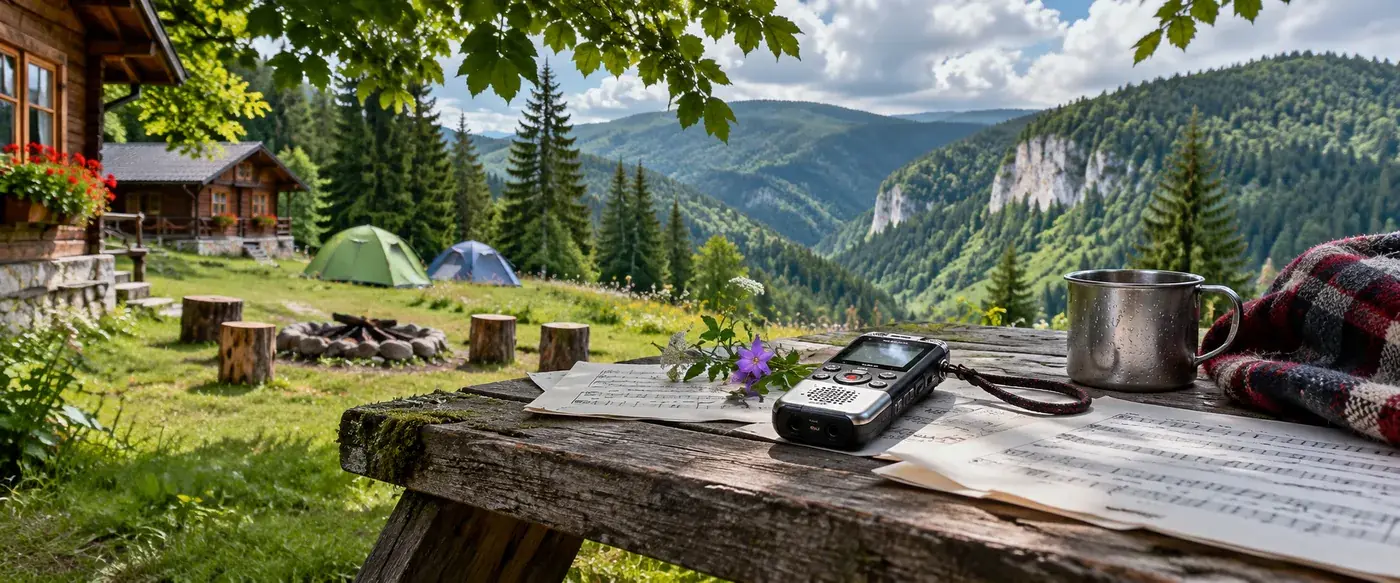
As the music camp ends, the conductor listens to the last test recorded outdoors. In one passage the voice of the pupil who was supposed to answer the choir from the opposite slope is missing. The boy had gone off to rehearse with a small recorder and instructions to return for lunch. His classmates heard him singing, but none of them saw him come down.
The rescuers call the mantrailing team. The boy's brother takes the handler the top the pupil had rehearsed in, in the lodge's hall. The recorder was also supposed to capture a spoken answer after the song. The conductor had asked him to say the word “fir”, so she would know where to cut the recording.
Four observers worked separately, each from a place where echo tests were being done. They mixed up their notes when they transcribed the sounds from the field. If you reconstruct the order of the transmissions, you can identify the observation that confirms the boy had reached his rehearsal spot.
You have four calls. Each person calls in once, from a different landmark, and each note belongs to a single call. The times are those of the calls. “Immediately before” means that no other call came in between. Who sent the message “The word “fir””, and from which landmark?
- Name · Dan, Daria, Sorin, Vlad
- Landmark · White Spur, Small Terrace, Dry Ford, Beech Saddle
- Note · Drumbeat, The word “fir”, Two claps, Long note
- Time · 11:02, 11:10, 11:18, 11:26
Search log
Field clues
I need a hint
Start with clue 1. The 11:10 sheet carries the note “Drumbeat”.
One more hint
For clue 2, try the position pairs 1 and 3 or 2 and 4, in both orders. Rule out the ones that do not fit the other messages.
Workbook
Deduction grid
The grid is optional. You can use it to organise your notes and see which options you have ruled out. If you already have the answer, go straight to the final report.
Pick the cell where the two values you want to compare meet.
How to play: the basics and a worked example
What do I have to do in a case?
- Read the story and the question in the final report: Who sent the message “The word “fir””, and from which landmark? That tells you what you have to reconstruct.
- Take the clues one at a time. Look for the two items each sentence links and note in the grid what you have learned. Then tick the clue so you remember you have used it. You can reread it at any time.
- If two clues share an item, follow it through both pairings. When you get stuck, you can open “I need a hint”, then “One more hint”.
- When you have a theory, fill in the two fields of the final report. You can send the report even if you left the grid empty. Then press “Check the report”. If the answer doesn't match, reread the clues and try again. Once it is confirmed, read the explanation in “The log, reconstructed”, shown below the report.
How do I correct a mark?
Tap the same cell to go through the three states, in order. You start from a dot. One tap puts ×, another puts ✓, and a third brings the dot back. So from ✓, a single tap clears the mark. The other cells only change when you tap them yourself.
How do I read the big grid in a case?
Above the columns you will see categories such as “Landmark” and “Note”. The rows are on the left. Follow the name on the row across to the column you are interested in and read the pairing as a question. A dot means you haven't noted the answer yet.
The one-match rule applies within each group of columns. After a ✓ you can put × in the other cells on the row and the column of the same group. In another group, the same row can have one more ✓.
Further down, the rows compare the remaining categories with each other. The hatched areas show pairings already covered elsewhere in the table. On a phone, swipe the table sideways to see the next group.
The example below is a made-up case with two dogs, Luna and Nori, who ended up in different places. The first clue says: “Luna did not finish the trail at the jetty.” Luna gets × under Jetty, so the greenhouse is all that is left for her and she gets ✓ there. The second clue says: “The team that reached the greenhouse used the bandana.”
| Reference | Place | Article | ||
|---|---|---|---|---|
| Jetty | Greenhouse | Bandana | Scarf | |
| Luna | ruled out | confirmed | confirmed | unknown |
| Nori | unknown | unknown | unknown | unknown |
| Jetty | Unused group of cells | unknown | unknown | |
| Greenhouse | confirmed | unknown | ||
On the “Greenhouse” row, the ✓ under “Bandana” comes straight from the clue. On the “Luna” row, the ✓ under “Bandana” is your own conclusion: Luna reached the greenhouse, and the team at the greenhouse used the bandana. The two ticks on Luna's row are in different groups.
Swipe the table to the left to see all the columns.
| Sheet | Landmark | Note | Time | |||||||||
|---|---|---|---|---|---|---|---|---|---|---|---|---|
Final report
Who sent the message “The word “fir””, and from which landmark?
The log, reconstructed
The dog team reaches the pupil, stopped at the edge of a forest clearing. He had saved his voice by shouting only when he heard people, and now he answers the conductor even without the recorder.
| Name | Landmark | Note | Time |
|---|---|---|---|
| Vlad | Small Terrace | Long note | 11:02 |
| Daria | Dry Ford | Drumbeat | 11:10 |
| Sorin | Beech Saddle | The word “fir” | 11:18 |
| Dan | White Spur | Two claps | 11:26 |
Solve another case
More cases of the same level from the collection.
-
 Case 182
Solved
The brick in the old photograph
At the restoration of a brick hall, a former bricklayer is invited to show his grandchildren the place where he marked the wall on his first day of work.
-
 Case 183
Solved
The picker's last basket
Before the collection centre closes, a woman notices that one of the baskets weighed in the morning has been left there.
-
 Case 184
Solved
Shadows in the camera obscura
At the photography festival, a retired teacher sets off to show a few children the upside-down image in a camera obscura.