
Trail Journal Case 184
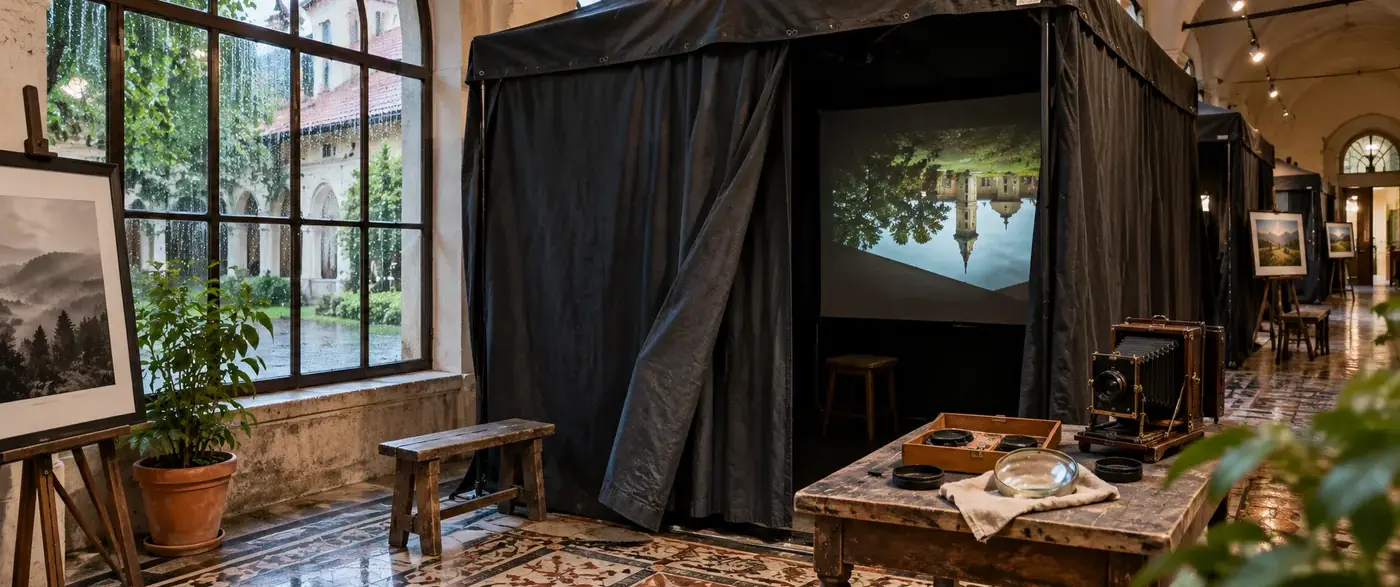
Shadows in the camera obscura
At what time and from where did the message “Upside-down poplar” come?
How the search began
What happened?
At the photography festival, a retired teacher sets off to show a few children the upside-down image in a camera obscura. Several installations have been set up in the building, in almost identical rooms. The children end up back at the entrance with another escort. The teacher, who had gone back for a lens, does not appear at the meeting with his daughter.
The organisers ask the police for help. The daughter has her father's scarf and hands it to the dog team. From his sample notebook she knows the teacher was looking for the installation in which a poplar tree was projected upside down on a white wall. That was the picture he had promised the children he would make clearer.
Four attendants have described the images in the rooms. Since work in the corridors was going on in the dark, the records also mention which call came before or after another call. Find the field sheet of the image the teacher was trying to set right.
You have four calls. Each person calls in once, from a different landmark, and each note belongs to a single call. The times are those of the calls. “Immediately before” means that no other call came in between. At what time and from where did the message “Upside-down poplar” come?
- Name · Carmen, Dan, Ovidiu, Radu
- Landmark · Small Workshop, Tower Room, Green Gallery, Lens Room
- Note · Red roof, White arcade, Round clock, Upside-down poplar
- Time · 16:11, 16:19, 16:27, 16:35
Search log
Field clues
I need a hint
Start with clue 2. The call from “Lens Room” was logged at 16:27.
One more hint
For clue 7, try the position pairs 1 and 3 or 2 and 4, in both orders. Rule out the ones that do not fit the other messages.
Workbook
Deduction grid
The grid is optional. You can use it to organise your notes and see which options you have ruled out. If you already have the answer, go straight to the final report.
Pick the cell where the two values you want to compare meet.
How to play: the basics and a worked example
What do I have to do in a case?
- Read the story and the question in the final report: At what time and from where did the message “Upside-down poplar” come? That tells you what you have to reconstruct.
- Take the clues one at a time. Look for the two items each sentence links and note in the grid what you have learned. Then tick the clue so you remember you have used it. You can reread it at any time.
- If two clues share an item, follow it through both pairings. When you get stuck, you can open “I need a hint”, then “One more hint”.
- When you have a theory, fill in the two fields of the final report. You can send the report even if you left the grid empty. Then press “Check the report”. If the answer doesn't match, reread the clues and try again. Once it is confirmed, read the explanation in “The log, reconstructed”, shown below the report.
How do I correct a mark?
Tap the same cell to go through the three states, in order. You start from a dot. One tap puts ×, another puts ✓, and a third brings the dot back. So from ✓, a single tap clears the mark. The other cells only change when you tap them yourself.
How do I read the big grid in a case?
Above the columns you will see categories such as “Landmark” and “Note”. The rows are on the left. Follow the name on the row across to the column you are interested in and read the pairing as a question. A dot means you haven't noted the answer yet.
The one-match rule applies within each group of columns. After a ✓ you can put × in the other cells on the row and the column of the same group. In another group, the same row can have one more ✓.
Further down, the rows compare the remaining categories with each other. The hatched areas show pairings already covered elsewhere in the table. On a phone, swipe the table sideways to see the next group.
The example below is a made-up case with two dogs, Luna and Nori, who ended up in different places. The first clue says: “Luna did not finish the trail at the jetty.” Luna gets × under Jetty, so the greenhouse is all that is left for her and she gets ✓ there. The second clue says: “The team that reached the greenhouse used the bandana.”
| Reference | Place | Article | ||
|---|---|---|---|---|
| Jetty | Greenhouse | Bandana | Scarf | |
| Luna | ruled out | confirmed | confirmed | unknown |
| Nori | unknown | unknown | unknown | unknown |
| Jetty | Unused group of cells | unknown | unknown | |
| Greenhouse | confirmed | unknown | ||
On the “Greenhouse” row, the ✓ under “Bandana” comes straight from the clue. On the “Luna” row, the ✓ under “Bandana” is your own conclusion: Luna reached the greenhouse, and the team at the greenhouse used the bandana. The two ticks on Luna's row are in different groups.
Swipe the table to the left to see all the columns.
| Sheet | Landmark | Note | Time | |||||||||
|---|---|---|---|---|---|---|---|---|---|---|---|---|
Final report
At what time and from where did the message “Upside-down poplar” come?
The log, reconstructed
The handler and the dog find him in the vestibule between two doors. The teacher had dropped his glasses and was waiting for someone with a light. First he shows them where to step so that the glasses stay in one piece.
| Name | Landmark | Note | Time |
|---|---|---|---|
| Dan | Tower Room | Red roof | 16:11 |
| Radu | Green Gallery | Upside-down poplar | 16:19 |
| Carmen | Lens Room | Round clock | 16:27 |
| Ovidiu | Small Workshop | White arcade | 16:35 |
Solve another case
More cases of the same level from the collection.
-
 Case 185
Solved
The island between two weirs
A team of volunteers is clearing the debris the flood has brought.
-
 Case 186
Solved
The message recorded in the tunnel
A railway enthusiast sets off to record the whistling of the air through the old ventilation shafts of a disused line.
-
 Case 187
Solved
The notebook from the smithy
At a smithy workshop, a girl helps her uncle take inventory of old tools.