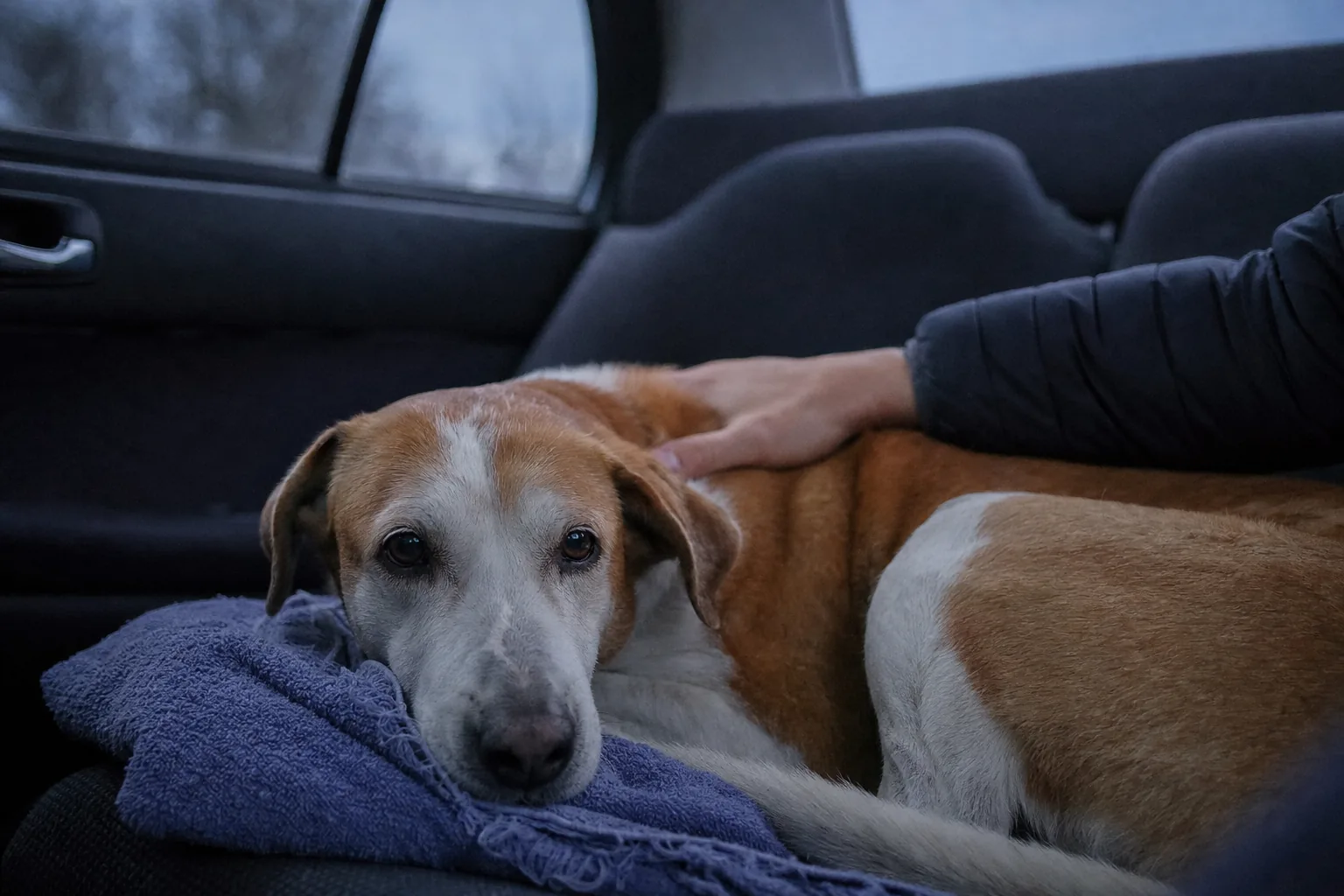
Emergency. Do not chase him or shout: a frightened dog runs further. Note the time and direction, leave someone at home with the gate open, put a worn jacket where you lost him, and if you see him, sit down, look away and talk quietly.
Noticed something different about your dog? Go straight to their vet.
Call your own vet or the nearest clinic with an emergency service now, and set off. Do not ask a group what to do: every answer you wait for there is time lost for the dog.
- The same sign, dozens of causes. A dog that vomits may have eaten grass or may have an object stuck in the gut. From two lines you typed, nobody can tell which. The vet feels the abdomen, takes the temperature, runs tests.
- Nobody on the internet sees your dog. They see a photo and a story. A diagnosis comes from an examination and investigations, not from a resemblance to someone else's dog.
- In groups you hear from the people whose dog "got better on its own". Those for whom it ended badly rarely post again. What you read there is a selection, not a statistic.
- Doses are calculated by weight and species. Human medicines that look harmless, paracetamol or ibuprofen, are toxic to dogs. "I gave mine half a tablet" is the most dangerous advice you can get.
- Hours matter. With a twisted stomach, a poisoning or a urinary blockage, the time spent asking online is exactly the time that decides the outcome.
- The vet is accountable for what they say. They have your dog's record, history, vaccinations, past treatments. An anonymous account has none of that and answers for nothing.
Use this page to know what to observe, what to note and what to ask at the appointment, not to treat at home. If you still have doubts after a consultation, ask another vet or a specialist (dermatologist, internist) for a second opinion, not a group. And if you do not have a regular vet yet, find one now, while your dog is healthy: how to choose a veterinary clinic.
The lead flew out of your hand at the first banger. Or the gate was left ajar after the delivery driver. Or the dog you adopted last week backed up, slipped his harness like a coat and turned the corner behind the flats. Now you are standing in the middle of the road with an empty lead, and everything in you says run after him, shouting his name. Do not run. A frightened dog on the run often goes into a state where he no longer recognises even his own person's voice, and shouting and footsteps behind him drive him further away. Below is what to do in the first minutes, who to ring in the first hours and what to change afterwards so you never go through this again.
The first 10 minutes
- Stop and watch where he goes. The direction, the corner he vanished round, the exact time. Write them in your phone; an hour from now you will not remember. If there are two of you, one stays exactly here.
- Do not run after him and do not shout. To a panicked dog, a person coming at a run is one more reason to bolt. If you spot him, stop, turn your shoulder to him, crouch or sit straight down on the pavement and look elsewhere. Talk quietly, yawn, rustle the treat bag. Dogs who have run from their own person standing up will come to that same person sitting down and not looking at them.
- If he is a confident dog who took off for the fun of it rather than from fear, run the other way making cheerful noises. That sort comes back for the game.
- Leave someone at home and open the gate. Many dogs find their own way back along the route they came, especially in the first hours. Someone has to be there, and the gate must not shut in his face.
- Leave something that smells of you and of him right where you lost him: a worn jacket, his blanket, his water bowl. Dogs often return to the last place they were with their person, especially after dark.
- Ring someone with a car and good treats and divide the streets between you. The car goes at walking pace; whoever is in the passenger seat looks under parked cars, into front gardens, stairwells, under bushes. A frightened dog hides. He does not stand in the middle of the pavement waiting for you.
- Check that the microchip is registered to your phone number and that the number on his collar tag is still current. If not, ring the vet who implanted the chip now and have the details changed.
The first hours
- Posters with his photo, in every direction, at 500 metres and then at a kilometre, at eye level: shops, bus stops, vet practices, pet shops, entrances to flats. A big, clear photo of his whole body. Little text: "LOST DOG", where, when, your number. Do not put every distinguishing mark on the poster; keep one back so you can test anyone who says they have found him.
- Neighbourhood groups and lost-pet groups for your town, with the photo, the place, the time and your number.
- The people who are out on the street all day: security guards, delivery drivers, the woman at the kiosk, other dog walkers, the children outside the flats. They see more than you do.
- At night, with a torch, along the route he ran. Many frightened dogs only start moving once the town goes quiet.
- Do not send money to anyone who says they have found him and wants "transport costs" before you have seen him with your own eyes. That scam does the rounds constantly.
Who to alert, including the vet practices
Vet practices in the area
Ring every practice and clinic within a few kilometres, including the out-of-hours ones. Whoever finds a dog often takes him to the nearest practice to have his chip read. Tell them:
- breed or what he looks like, colour, size, sex, age;
- his microchip number;
- the area and the time he went missing;
- whether he has an illness or is on treatment, whether he is frightened and might bite;
- your phone number.
Leave a poster at each practice and ring again every two or three days.
Shelters
Ring the town's (or district's) public shelter and the private rescues nearby, then go in person. Over the phone, a medium-sized black dog sounds like ten others. Go every two or three days for as long as he is missing. Ask how long they keep dogs they pick up before rehoming them, and how you claim yours back.
Local police and the council
Tell the local police or the council, especially if he went missing near a busy road. They are sometimes the first to hear when a dog has been hit by a car. It is a hard call to make and a hard one to receive. It is still better than not knowing.
Once you have him: to the vet
Even if he looks fine, book him in the same day or the next. The vet checks:
- wounds hidden under the coat: bites, scratches, cuts in the pads;
- ticks and parasites picked up along the way;
- hydration and temperature, especially after a frosty night or a scorching day;
- what he has eaten: lost dogs eat from bins and sometimes poisoned baits; tell the vet how many days he was gone;
- the chip, read again, and the details on the database.
At home, keep him quiet for a few days, with short walks on a double lead. A dog who has escaped once is most ready to escape again in the very first week afterwards.
What to change so it does not happen again
What makes him easy to find
- The microchip, compulsory for dogs in Romania, the UK and many other countries, and its registration on the national database under your name and current phone number. Check now, not afterwards. When you change number or address, change the database too.
- A collar tag engraved with your number. Not written in biro, which washes off in the first shower. Only someone with a scanner can read a chip; anyone can read a tag.
- Recent photos, from every side, whole body, in a separate album on your phone.
- Something that smells of him, unwashed, in a clean bag nobody else touches (a blanket, an old harness). There are teams with trailing dogs that search for lost pets. We train dogs to find people by scent, and we know from the trail how much a clean scent article matters: start from one the whole family has handled and the dog sets off after the wrong person.
What keeps him with you
- An escape-proof harness for fearful dogs, newly adopted dogs or dogs who have slipped out before. It has a second strap round the belly and cannot be pulled off over the head. In the first weeks after adoption, clip the lead to both harness and collar, with two clips.
- The fence and the gate. Gaps under the fence, torn mesh, a gate that does not close by itself. A dog who has jumped the fence once will do it again.
- Doors and visitors. The delivery driver, the plumber, children coming round. On days with people coming and going, the dog stays in a room with the door shut.
- The car. He gets out only after you have clipped the lead on. Never on his own, not even "because he knows".
- Firework nights (New Year, Bonfire Night, weddings, matches): a short walk on a double lead before dark; windows shut; the dog indoors, not in the garden.
- A recall, taught at home and practised every week, plus a second, emergency signal that you keep only for the day it really matters.
- A long line in open spaces for dogs without a reliable recall, especially hunting breeds and recently adopted dogs.
Most lost dogs are found close to home, by people who searched the neighbourhood methodically and told everyone. Check today, while he is asleep beside you, which phone number the database shows against his chip.
Frequently asked questions
What dog owners search for most often on the internet about this problem, with the short answer. The answers are a guide only: the decision belongs to your dog's own vet, after an examination.
How do I find a lost dog?
Start where he disappeared: someone stays there, someone else waits at home with the gate open. Search slowly, by car and on foot, under cars, in stairwells, under bushes. Put up posters with a photo at 500 metres and at a kilometre, post in neighbourhood groups, ring every vet practice and shelter in the area, then visit the shelters in person.
Why won't my lost dog come when I call him?
Many frightened dogs go into a flight state in which they no longer recognise even their own person's voice, and shouting and chasing push them further away. Sit down, shoulder towards him, look elsewhere, talk quietly and rustle the treat bag. A person sitting on the ground is far less frightening than one running.
Does a microchip help if my dog gets lost?
Yes, if it is registered on the database under your name and your current phone number. Vet practices and shelters scan every dog brought to them. Check the details now, not after he goes missing. Add an engraved tag with your number too: only someone with a scanner can read a chip, anyone can read a tag.
Will a lost dog come home on his own?
Sometimes, especially in the first hours and at night, along the route he came or to the last place he was with you. That is why you leave someone at home with the gate open and a jacket you have worn where you lost him. Do not rely on that alone: put up posters and ring the practices and shelters at the same time.
The information on this page is educational and does not replace an examination. For full details and a diagnosis, consult your dog's own veterinarian.