
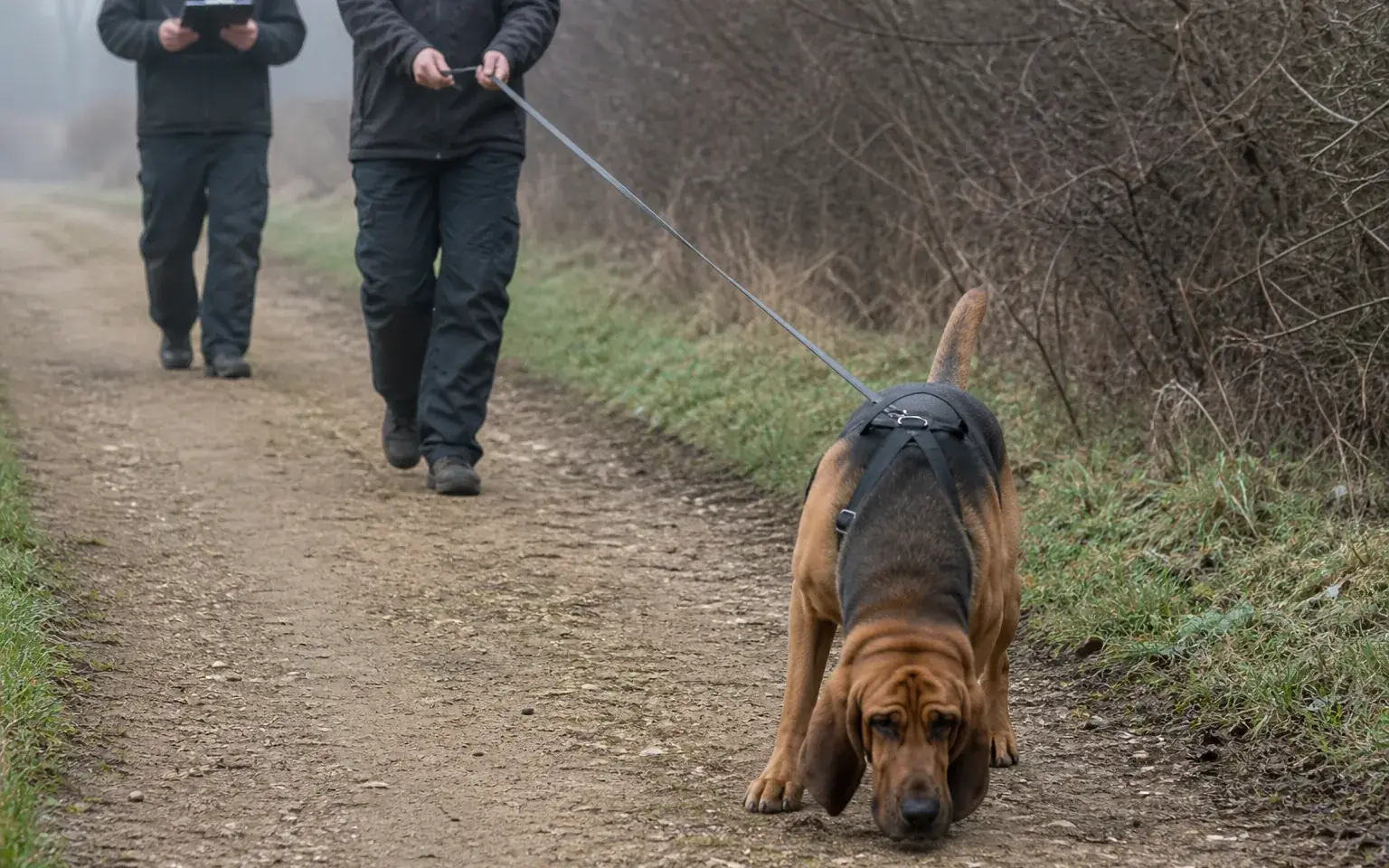
Handler and shepherd dog on the trial field, the judge with the score sheet in the background

International certification

Mantrailing in the UK: no single national regulation

Unlike Germany, Switzerland or Poland, the United Kingdom has no nationally regulated recreational mantrailing certification - each private school sets its own levels and criteria, rarely published in full. The exception is NSARDA, the national operational organisation (a registered charity) for search-and-rescue dogs, where "Trailing" is one of 3 recognised disciplines.

NSARDA - the real operational organisation

NSARDA (National Search And Rescue Dog Association) is a registered charity (no. 1161859) bringing together volunteer search-and-rescue teams across the UK, Ireland, the Isle of Man and Northern Ireland. It works with three types of dog: Air Scenting (off-lead, handler-directed, catching human scent from the air), Trailing (on-lead, given a scent article by the handler) and Water Search.

Becoming an operational team means recruitment, supervised training and assessment by local and national assessors, per NSARDA's internal standards - there is no single public document with exact figures (trail length, trail age), unlike the German or Swiss organisations described above.

Private recreational mantrailing schools

Besides NSARDA, several private schools offer their own sport/recreational mantrailing certifications, each with its own level system: Mantrailing Global (founded by Lisa Gorenflo in 2017, with accredited instructors and levels obtained in person or online) and The Canine School of Trailing (TCSOT) (founded by Marilyn Gilchrist and Rachel Rodgers, 5 assessment levels).

Important: neither school publishes the exact level figures (trail length, trail age) in full on its own site. The table below comes from an independent comparison guide, not from each school's own regulations - we treat it as indicative, not as a primary official source.

Organisation Levels Distance (approximate) Trail age (approximate)
Mantrailing Global 3 (Level 1-3) 200-400 m (L1) up to 600-1,000 m (L3) 30-60 minutes (L1) up to 2-4 hours (L3)
TCSOT 5 (Beginner - Expert) 200 m (Beginner) up to 1,500 m (Expert) 1 minute (Beginner) up to 24 hours (Expert)

Source: an independent comparison guide (dogtrailing.co.uk), not each organisation's official regulations - the Mantrailing Global and TCSOT websites do not publish these figures in full.

Official regulations

The figures on this page come from the document below; on trial day the text of the regulations is what counts.

Related pages

Questions and answers

Frequently asked questions

Is there a national mantrailing certification in the UK?

No, for recreational/sport mantrailing - each private school has its own levels. NSARDA is the real operational organisation, for search-and-rescue, but even there the standards are internal, not one public document.
What is NSARDA?

A registered charity bringing together volunteer search-and-rescue teams across the UK, Ireland, the Isle of Man and Northern Ireland, with Trailing as one of 3 recognised canine disciplines.

Can the figures in the levels table be trusted?

They are indicative - they come from an independent comparison guide, not from each school's own published regulations, because those are not published in full.

Can a team from outside the UK take part?

At the private schools, generally yes, for a fee, like any commercial course. At NSARDA, operational readiness is tied to being integrated into a local team within the UK/Ireland network.

Want to know where to start?

See all the certifications explained step by step, with the official regulations.