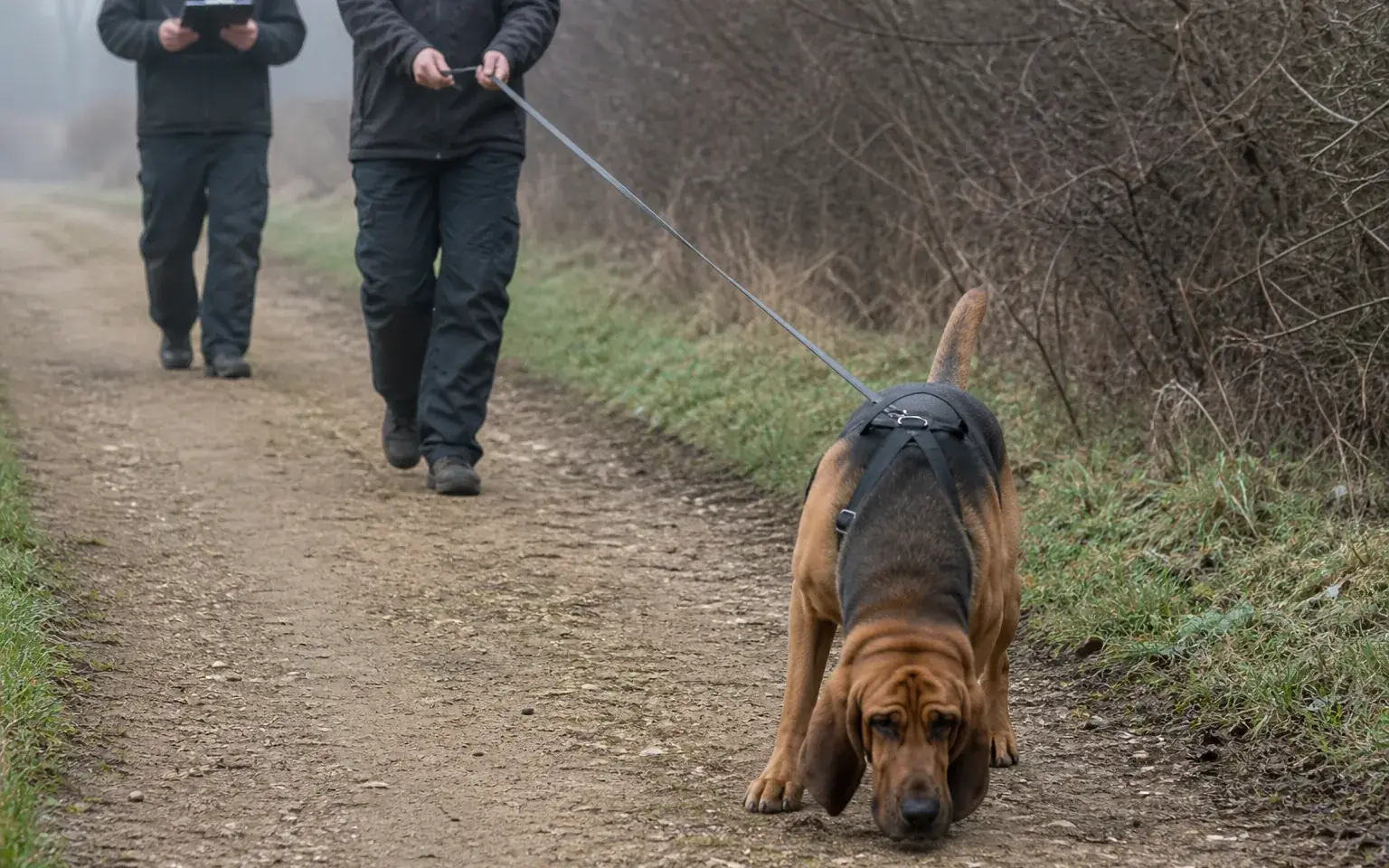
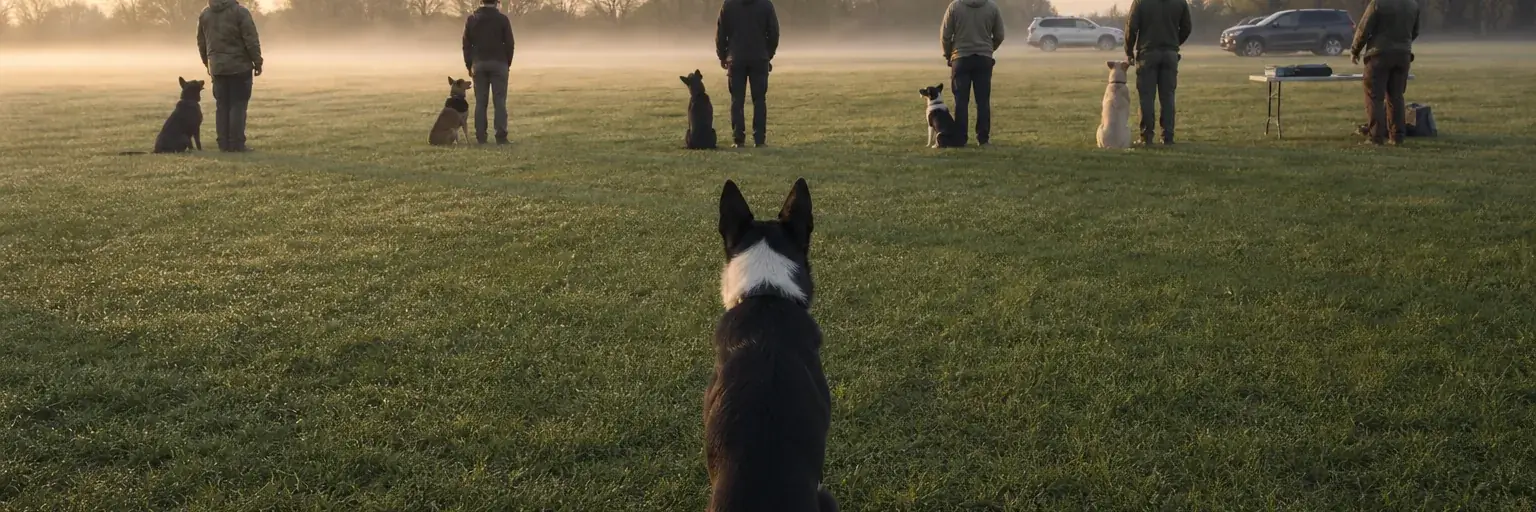
Handler and shepherd dog on the trial field, the judge with the score sheet in the background

International certification

GAK9 Sportrailing: international certification by terrain class

GAK9 (Georgia K9 National Training Center, USA - the method developed by Jeff Schettler) certifies mantrailing teams across 4 terrain classes - Field, Rural, Suburban, Urban - each with 4 levels: Handler, Specialist, Expert, Master. The GAK9 network also has trainers in Europe (Germany, Switzerland, Austria, the Netherlands, Spain, Belgium, Latvia), not only in the US.

What is GAK9 Sportrailing certification?

GAK9 is a K-9 trailing training centre in Georgia, USA, whose certified trainers work to a method that has expanded internationally - Europe has its own network of GAK9 trainers and monitors, across several countries.

The certification measures exclusively the dog's ability to follow an individual trail (trailing) - the standards state explicitly that a find based on area-search (air-scent pattern) work is not valid for certification.

Who can enter, and who may certify

  • A team must always start at the "Handler" level, in whichever terrain class, and work up in order, with no level skipped.
  • A team may switch terrain class at any time, but restarts every time at the "Handler" level in the new class.
  • Certification may be carried out by any GAK9 trainer, but only up to the level that trainer is themself certified to train at - for example, a Level 1 GAK9 trainer may only certify the "Handler" level, in any of the 4 classes.

The 4 terrain classes

  • Field: open grassy areas, brush, desert or woods; little to no human contamination; primarily soft surface.
  • Rural: as above, plus simple surface changes (dirt roads, small streets); a small amount of human contamination; about 20% surface changes.
  • Suburban: industrial areas or business parks, with more human activity but confined to the structures, off hours; roughly 50/50 hard and soft surface.
  • Urban: a city-type setting with high human and vehicle traffic; a mixture of hard and soft surface.

The levels, by terrain class

Class Level Trail length Trail age Time limit
Field Handler 500-600 m, minimum 1 turn 30 minutes 15 minutes
Field Specialist 700-800 m, minimum 2 turns 1 hour 25 minutes
Field Expert 800-1,000 m, minimum 3 turns, at least one road crossing 2 hours 35 minutes
Field Master 1,000-1,500 m, minimum 3 turns, at least two crossings + one obstacle to bypass 4 hours 45 minutes
Rural Handler 500-600 m, minimum 1 turn, at least one surface change 30 minutes 15 minutes
Rural Specialist 700-800 m, minimum 2 turns, at least one surface change 1 hour 25 minutes
Rural Expert 800-1,000 m, minimum 3 turns, at least two surface changes 2 hours 35 minutes
Rural Master 1,000-1,500 m, minimum 3 turns, at least two surface changes + one obstacle 4 hours 45 minutes
Suburban Handler 400-500 m, minimum 1 turn, at least one surface change 30 minutes 15 minutes
Suburban Specialist 600-700 m, minimum 2 turns, at least one surface change 1 hour 20 minutes
Suburban Expert 800-1,000 m, minimum 3 turns, at least two surface changes, distractions expected 2 hours 30 minutes
Suburban Master 1,000-1,500 m, minimum 3 turns, at least two surface changes, with distractions 4 hours 45 minutes
Urban Handler 400-500 m, minimum 1 turn, at least one surface change 30 minutes 15 minutes
Urban Specialist 600-700 m, minimum 2 turns, at least one surface change 1 hour 20 minutes
Urban Expert 800-1,000 m, minimum 3 turns, at least two surface changes 2 hours 40 minutes
Urban Master 1,000-1,500 m, minimum 3 turns, at least two surface changes 4 hours 50 minutes

Source: GAK9 Sportrailing Certification Standards. The starting surface varies by class/level: in Field and Rural it stays mostly soft at every level; in Suburban and Urban, from Specialist level up it may also be hard.

How the evaluation works

  • The trail is double-blind; the distance and age of the trail are approximate, since the trail-layer may encounter unforeseen conditions.
  • The team must find the trail-layer within the time limit, but the evaluator may extend this limit at their discretion (for example if the trail is longer than planned).
  • A find based on a dog working in air-scent (area search) patterns is not valid for certification.
  • Both the trail-layer and the handler carry a GPS tracking device; the tracks are laid on top of each other after the certification, and the evaluator has the final decision on passing or failing the team.
  • Any disrespectful behaviour towards the evaluator, or against animal welfare, results in disqualification.
  • In case of failure, the team can repeat the certification as often as they want.

The scent article

  • Provided by the trail-layer in a jar or other suitable container, before the trail is laid.
  • May be placed directly at the start of the trail, or left in the care of an expert witness.
  • From Specialist level up, the scent article may also be fixed (not just moveable) - in that case, the trail-layer must ensure enough scent has been deposited on the object.

Official regulations

The figures on this page come from the document below; on trial day the text of the regulations is what counts.

Related pages

Questions and answers

Frequently asked questions

What is GAK9 Sportrailing certification?

An international mantrailing certification developed by Georgia K9 (USA), across 4 terrain classes (Field, Rural, Suburban, Urban) and 4 levels each (Handler, Specialist, Expert, Master). It assesses only true trail-following, not area-search work.

How many levels and classes does GAK9 certification have?

4 terrain classes, each with 4 levels, so 16 possible combinations. A team always starts at "Handler" in the chosen class and works up in order, with no level skipped.

Who may certify a team?

Any GAK9 trainer, but only up to the level they are themself certified to train at - a Level 1 trainer may only certify the Handler level, in any of the 4 classes.

Can a team from outside the US take part?

Yes. GAK9 has a network of trainers and monitors in Europe too - Germany, Switzerland, Austria, the Netherlands, Spain, Belgium and Latvia - so certification is not limited to the US.

Want to know where to start?

See all the certifications explained step by step, with the official regulations.