
Trail Journal Case 196
The water line on the map
At what time and from where did the message “Square on wave” come?
How the search began
What happened?
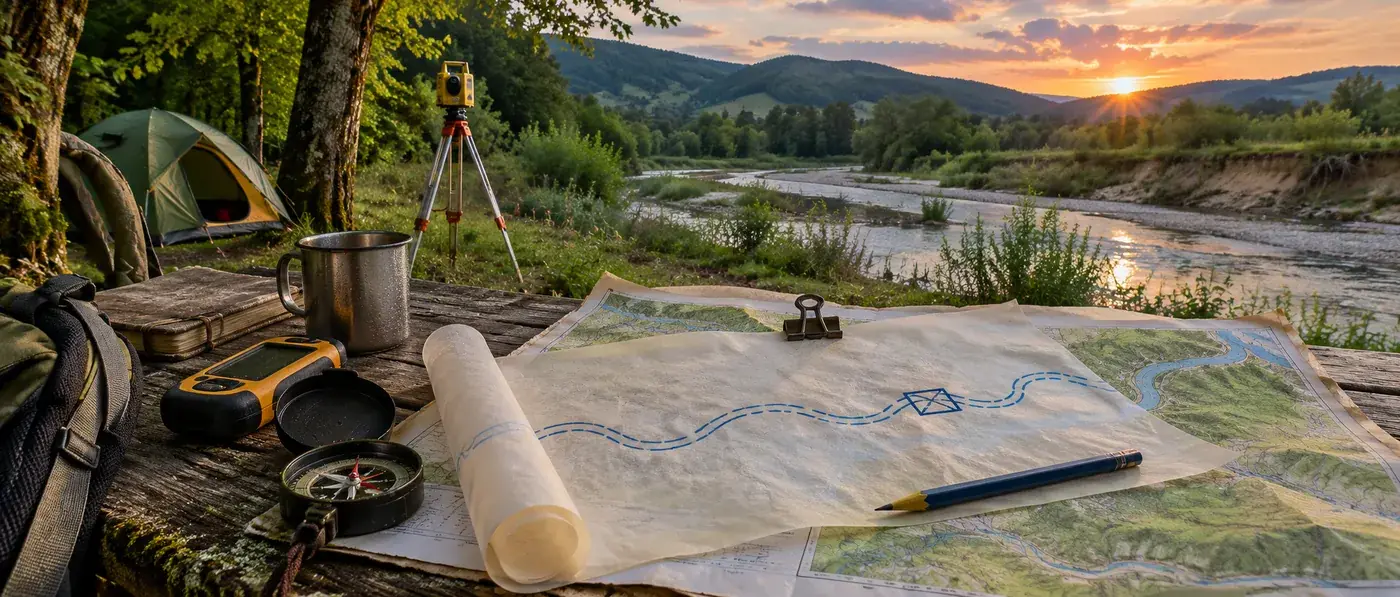
At the end of a day of surveying, the students lay the bank maps out on the table to see how the waterline changes from one year to the next. The group's supervisor went to check a marker in the field and has not come back. On his tracing sheet there is a wavy line interrupted by a square. It was how he marked a crossing over a ditch.
The students ask the rescuers for support. The mantrailing team's dog is given the pullover the professor wore in the morning. They had seen him take a copy of the map with the square marker, but there are several similar crossings along the canal. The students check which copies were shown to passers-by on the bank.
The dispatch centre received four descriptions, each with its own time. In one of the calls, the square in the wavy line was mentioned exactly. Rebuild the field sheet that would show the rescuers where the professor's map was consulted.
You have four calls. Each person calls in once, from a different landmark, and each note belongs to a single call. The times are those of the calls. “Immediately before” means that no other call came in between. At what time and from where did the message “Square on wave” come?
- Name · Ada, Ina, Liviu, Ovidiu
- Landmark · Small Dyke, Crooked Bank, Willow Culvert, Clay Sill
- Note · Closed circle, Line with arrow, Square on wave, Double triangle
- Time · 16:07, 16:12, 16:17, 16:22
Search log
Field clues
I need a hint
Start with clue 6. The message from “Small Dyke” includes the note “Line with arrow”.
One more hint
For clue 1, try the position pairs 1 and 3 or 2 and 4, in both orders. Rule out the ones that do not fit the other messages.
Workbook
Deduction grid
The grid is optional. You can use it to organise your notes and see which options you have ruled out. If you already have the answer, go straight to the final report.
Pick the cell where the two values you want to compare meet.
How to play: the basics and a worked example
What do I have to do in a case?
- Read the story and the question in the final report: At what time and from where did the message “Square on wave” come? That tells you what you have to reconstruct.
- Take the clues one at a time. Look for the two items each sentence links and note in the grid what you have learned. Then tick the clue so you remember you have used it. You can reread it at any time.
- If two clues share an item, follow it through both pairings. When you get stuck, you can open “I need a hint”, then “One more hint”.
- When you have a theory, fill in the two fields of the final report. You can send the report even if you left the grid empty. Then press “Check the report”. If the answer doesn't match, reread the clues and try again. Once it is confirmed, read the explanation in “The log, reconstructed”, shown below the report.
How do I correct a mark?
Tap the same cell to go through the three states, in order. You start from a dot. One tap puts ×, another puts ✓, and a third brings the dot back. So from ✓, a single tap clears the mark. The other cells only change when you tap them yourself.
How do I read the big grid in a case?
Above the columns you will see categories such as “Landmark” and “Note”. The rows are on the left. Follow the name on the row across to the column you are interested in and read the pairing as a question. A dot means you haven't noted the answer yet.
The one-match rule applies within each group of columns. After a ✓ you can put × in the other cells on the row and the column of the same group. In another group, the same row can have one more ✓.
Further down, the rows compare the remaining categories with each other. The hatched areas show pairings already covered elsewhere in the table. On a phone, swipe the table sideways to see the next group.
The example below is a made-up case with two dogs, Luna and Nori, who ended up in different places. The first clue says: “Luna did not finish the trail at the jetty.” Luna gets × under Jetty, so the greenhouse is all that is left for her and she gets ✓ there. The second clue says: “The team that reached the greenhouse used the bandana.”
| Reference | Place | Article | ||
|---|---|---|---|---|
| Jetty | Greenhouse | Bandana | Scarf | |
| Luna | ruled out | confirmed | confirmed | unknown |
| Nori | unknown | unknown | unknown | unknown |
| Jetty | Unused group of cells | unknown | unknown | |
| Greenhouse | confirmed | unknown | ||
On the “Greenhouse” row, the ✓ under “Bandana” comes straight from the clue. On the “Luna” row, the ✓ under “Bandana” is your own conclusion: Luna reached the greenhouse, and the team at the greenhouse used the bandana. The two ticks on Luna's row are in different groups.
Swipe the table to the left to see all the columns.
| Sheet | Landmark | Note | Time | |||||||||
|---|---|---|---|---|---|---|---|---|---|---|---|---|
Final report
At what time and from where did the message “Square on wave” come?
The log, reconstructed
The team finds the professor beside a crossing with displaced planks. On the way back he preferred to wait for help. A student holds his map while he climbs into the rescuers' boat.
| Name | Landmark | Note | Time |
|---|---|---|---|
| Ina | Clay Sill | Closed circle | 16:07 |
| Ovidiu | Crooked Bank | Double triangle | 16:12 |
| Liviu | Willow Culvert | Square on wave | 16:17 |
| Ada | Small Dyke | Line with arrow | 16:22 |
Solve another case
More cases of the same level from the collection.
-
 Case 197
Solved
The song between two bells
In the old town centre, an organ tuner helps restore the sound of a street instrument.
-
 Case 198
Solved
The glint in the upper lake
A member of a hiking club turns back to retrieve a metal box in which he keeps family photographs.
-
 Case 199
Solved
The display case seen in the mirror
While an exhibition is being installed, a set designer walks the corridors with a mirror in her hand.