
Trail Journal Case 057
The fallen tree
At what time, and at which landmark, was the stretcher requested?
The real case · Devon & Cornwall Police
In Cornwall, a police dog unit located a man after midnight, trapped by a fallen tree in an isolated wood.
How the search began
What happened?
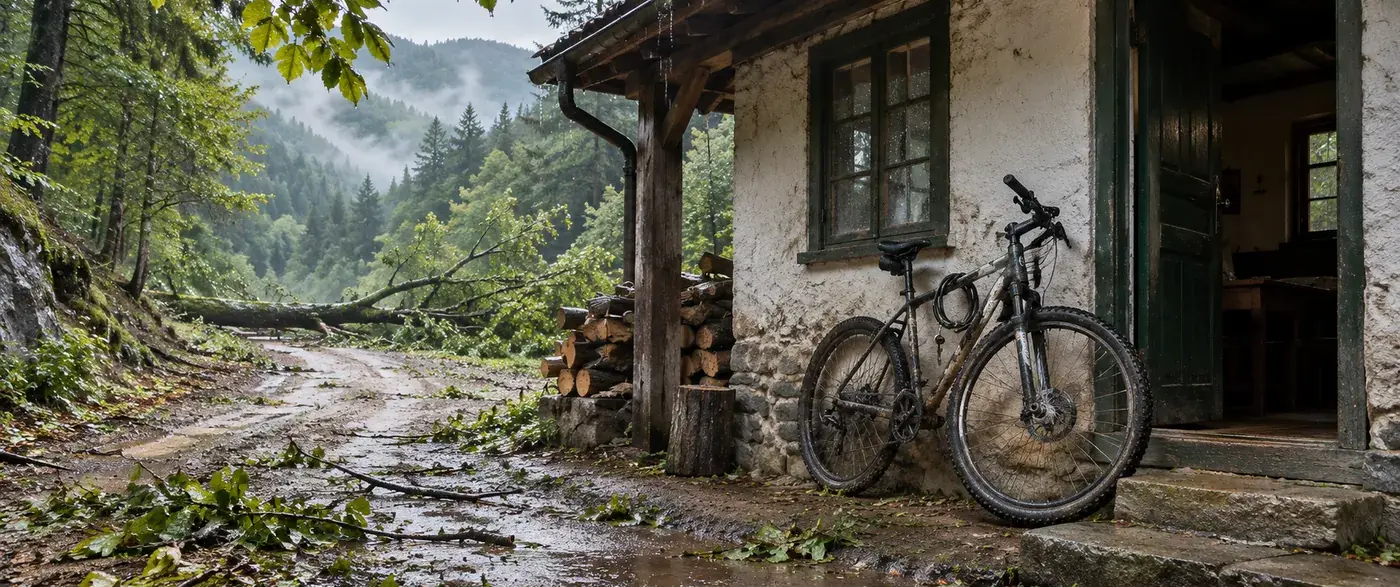
A forester's brother has found the bicycle leaning against the ranger's lodge, with the key still in the lock. The forester has not come back. The two brothers have a habit of leaving a sign when they return separately: a bicycle with its front wheel towards the road means the man still has work in the forest. Today the bicycle stands just as it was left this morning. The brother shouts from the doorway of the lodge and waits. The overnight rain has left branches all over the road, and nothing he can see tells him where to look first.
The police ask for the help of a mantrailing team, and the brother brings the hat his brother wore this morning. The handler reaches a fallen tree and asks for a stretcher. In the night log there are three requests for equipment.
At the response vehicle, a rescuer is already lifting the stretcher from its rack, but his colleague has three requests on the screen. The people who made them are working in different places. Before setting out along the dark road, the handler's request has to be matched to the right recording.
You have three field sheets. Each landmark and each note appears on one sheet only. At what time, and at which landmark, was the stretcher requested?
- Time · 00:12, 00:21, 00:30
- Landmark · Lower Ranger's Lodge, Pine Bend, Forest Bridge
- Note · Blanket, Floodlight, Stretcher
Search log
Field clues
I need a hint
Start with the one certain pairing, “Forest Bridge” and “Blanket”.
One more hint
Once you have paired them, rule out “Blanket” for the other two values in the “Landmark” category. Each value is used only once.
Workbook
Deduction grid
The grid is optional. You can use it to organise your notes and see which options you have ruled out. If you already have the answer, go straight to the final report.
Pick the cell where the two values you want to compare meet.
How to play: the basics and a worked example
What do I have to do in a case?
- Read the story and the question in the final report: At what time, and at which landmark, was the stretcher requested? That tells you what you have to reconstruct.
- Take the clues one at a time. Look for the two items each sentence links and note in the grid what you have learned. Then tick the clue so you remember you have used it. You can reread it at any time.
- If two clues share an item, follow it through both pairings. When you get stuck, you can open “I need a hint”, then “One more hint”.
- When you have a theory, fill in the two fields of the final report. You can send the report even if you left the grid empty. Then press “Check the report”. If the answer doesn't match, reread the clues and try again. Once it is confirmed, read the explanation in “The log, reconstructed”, shown below the report.
How do I correct a mark?
Tap the same cell to go through the three states, in order. You start from a dot. One tap puts ×, another puts ✓, and a third brings the dot back. So from ✓, a single tap clears the mark. The other cells only change when you tap them yourself.
How do I read the big grid in a case?
Above the columns you will see categories such as “Landmark” and “Note”. The rows are on the left. Follow the name on the row across to the column you are interested in and read the pairing as a question. A dot means you haven't noted the answer yet.
The one-match rule applies within each group of columns. After a ✓ you can put × in the other cells on the row and the column of the same group. In another group, the same row can have one more ✓.
Further down, the rows compare the remaining categories with each other. The hatched areas show pairings already covered elsewhere in the table. On a phone, swipe the table sideways to see the next group.
The example below is a made-up case with two dogs, Luna and Nori, who ended up in different places. The first clue says: “Luna did not finish the trail at the jetty.” Luna gets × under Jetty, so the greenhouse is all that is left for her and she gets ✓ there. The second clue says: “The team that reached the greenhouse used the bandana.”
| Reference | Place | Article | ||
|---|---|---|---|---|
| Jetty | Greenhouse | Bandana | Scarf | |
| Luna | ruled out | confirmed | confirmed | unknown |
| Nori | unknown | unknown | unknown | unknown |
| Jetty | Unused group of cells | unknown | unknown | |
| Greenhouse | confirmed | unknown | ||
On the “Greenhouse” row, the ✓ under “Bandana” comes straight from the clue. On the “Luna” row, the ✓ under “Bandana” is your own conclusion: Luna reached the greenhouse, and the team at the greenhouse used the bandana. The two ticks on Luna's row are in different groups.
Swipe the table to the left to see all the columns.
| Sheet | Landmark | Note | ||||
|---|---|---|---|---|---|---|
Final report
At what time, and at which landmark, was the stretcher requested?
The log, reconstructed
Under the trunk, the forester is able to talk to the rescuers. The crew that arrived with the stretcher take him over, and his brother takes the bicycle home for when he can use it again.
| Time | Landmark | Note |
|---|---|---|
| 00:12 | Forest Bridge | Blanket |
| 00:21 | Pine Bend | Floodlight |
| 00:30 | Lower Ranger's Lodge | Stretcher |
The real case
In Cornwall, a police dog unit located a man after midnight, trapped by a fallen tree in an isolated wood.
Solve another case
More cases of the same level from the collection.
-
 Case 058
Solved
The light on the plateau
A hiker promised to send a photograph when he reached the plateau.
-
 Case 059
Solved
Voices in the gully
Two sisters are coming back from the summit by a different route from the one they climbed.
-
 Case 060
Solved
Six went up, four came down
Six bowls of soup are laid out at the mountain hut, but only four hikers come through the door.