
Trail Journal Case 150
The circle on the ice
At what time and from where did the call with the note “Sand circle” come?
How the search began
What happened?
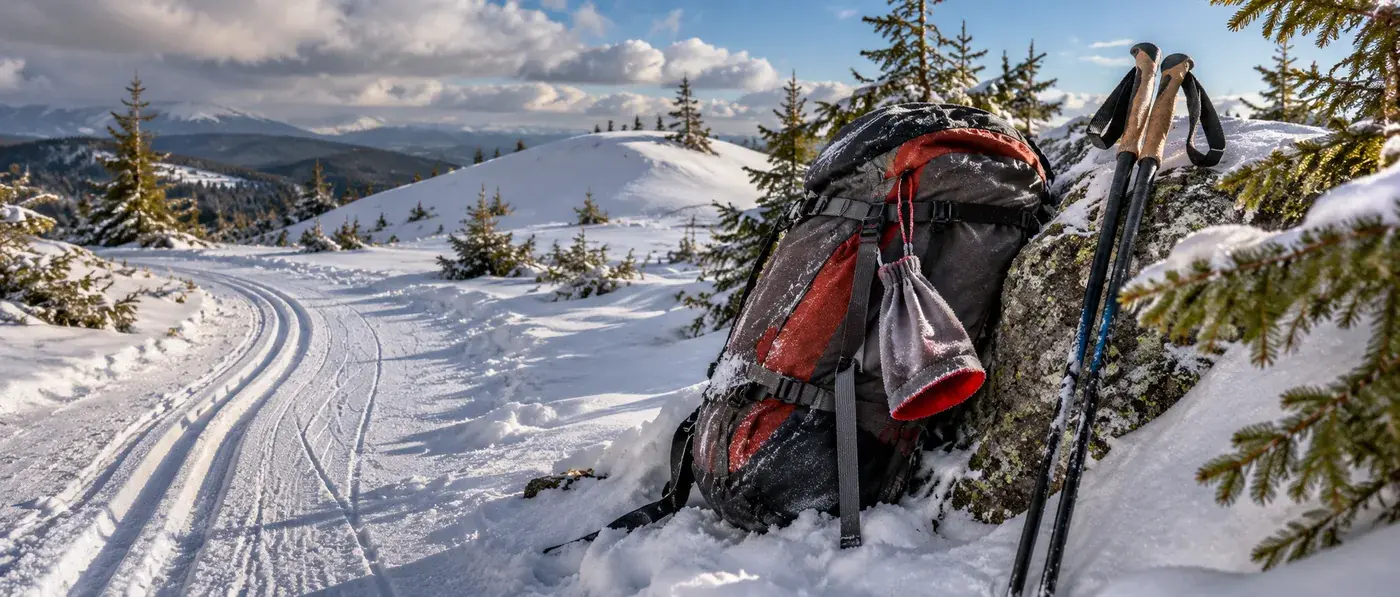
On a cross-country ski trail, a participant turns back to retrieve his glasses pouch and misses the meeting with the group. At the last stop, the instructor had seen him polishing the lenses with the pouch turned inside out. The boy had then tied it to his rucksack, and on the descent the light fabric had started to flutter. When the others gather out of the wind, one of the colleagues remembers that the skier had signalled him to go on ahead. Then a white mound had hidden them from each other.
The instructor alerts the rescuers. In his last message, the skier had said he could see a circle drawn in sand for the children's contest. Three teams describe marks on the ground.
The children who prepared the contest can describe the circle very well: they had carried the sand in little buckets and scattered it so that even their gloves had gone rough. Someone also noticed the mark during the search. The place of that sighting helps the team find the skier again.
You have three calls. Each has a signature, a landmark and a note. Each value appears only once. The times are those of the calls. “Immediately before” means that no other call came in between the two. At what time and from where did the call with the note “Sand circle” come?
- Name · Filip, Petru, Sabina
- Landmark · Spruce Bend, School Plateau, Ski Meadow
- Note · Sand circle, Chalk line, Sled tracks
- Time · 12:07, 12:14, 12:21
Search log
Field clues
I need a hint
Start with clue 6. The sheet signed by Sabina carries the note “Chalk line”.
One more hint
Combine clues 1 and 2. Together they give you one more pairing. The call from “School Plateau” was logged at 12:07.
Workbook
Deduction grid
The grid is optional. You can use it to organise your notes and see which options you have ruled out. If you already have the answer, go straight to the final report.
Pick the cell where the two values you want to compare meet.
How to play: the basics and a worked example
What do I have to do in a case?
- Read the story and the question in the final report: At what time and from where did the call with the note “Sand circle” come? That tells you what you have to reconstruct.
- Take the clues one at a time. Look for the two items each sentence links and note in the grid what you have learned. Then tick the clue so you remember you have used it. You can reread it at any time.
- If two clues share an item, follow it through both pairings. When you get stuck, you can open “I need a hint”, then “One more hint”.
- When you have a theory, fill in the two fields of the final report. You can send the report even if you left the grid empty. Then press “Check the report”. If the answer doesn't match, reread the clues and try again. Once it is confirmed, read the explanation in “The log, reconstructed”, shown below the report.
How do I correct a mark?
Tap the same cell to go through the three states, in order. You start from a dot. One tap puts ×, another puts ✓, and a third brings the dot back. So from ✓, a single tap clears the mark. The other cells only change when you tap them yourself.
How do I read the big grid in a case?
Above the columns you will see categories such as “Landmark” and “Note”. The rows are on the left. Follow the name on the row across to the column you are interested in and read the pairing as a question. A dot means you haven't noted the answer yet.
The one-match rule applies within each group of columns. After a ✓ you can put × in the other cells on the row and the column of the same group. In another group, the same row can have one more ✓.
Further down, the rows compare the remaining categories with each other. The hatched areas show pairings already covered elsewhere in the table. On a phone, swipe the table sideways to see the next group.
The example below is a made-up case with two dogs, Luna and Nori, who ended up in different places. The first clue says: “Luna did not finish the trail at the jetty.” Luna gets × under Jetty, so the greenhouse is all that is left for her and she gets ✓ there. The second clue says: “The team that reached the greenhouse used the bandana.”
| Reference | Place | Article | ||
|---|---|---|---|---|
| Jetty | Greenhouse | Bandana | Scarf | |
| Luna | ruled out | confirmed | confirmed | unknown |
| Nori | unknown | unknown | unknown | unknown |
| Jetty | Unused group of cells | unknown | unknown | |
| Greenhouse | confirmed | unknown | ||
On the “Greenhouse” row, the ✓ under “Bandana” comes straight from the clue. On the “Luna” row, the ✓ under “Bandana” is your own conclusion: Luna reached the greenhouse, and the team at the greenhouse used the bandana. The two ticks on Luna's row are in different groups.
Swipe the table to the left to see all the columns.
| Sheet | Landmark | Note | Time | ||||||
|---|---|---|---|---|---|---|---|---|---|
Final report
At what time and from where did the call with the note “Sand circle” come?
The log, reconstructed
The rescuers reach the circle and hear him answering from among the firs. A ski binding had broken. The instructor waits for him at the end of the trail with dry boots.
| Name | Landmark | Note | Time |
|---|---|---|---|
| Filip | School Plateau | Sand circle | 12:07 |
| Sabina | Ski Meadow | Chalk line | 12:14 |
| Petru | Spruce Bend | Sled tracks | 12:21 |
Solve another case
More cases of the same level from the collection.
-
 Case 151
Solved
The tassel on the drum
After the brass band's parade, a little girl follows the drummer who had promised to let her hit the drum once.
-
 Case 152
Solved
The sailmaker's mark
A craftsman sets off on foot to measure a sail.
-
 Case 153
Solved
The hour on the sundial
At the sundial's inauguration, the designer goes off to look for a part and is late for the group photograph.