
Trail Journal Case 192
Free wheel at the lock
At what time and from where did the message “Crooked welded spoke” come?
How the search began
What happened?
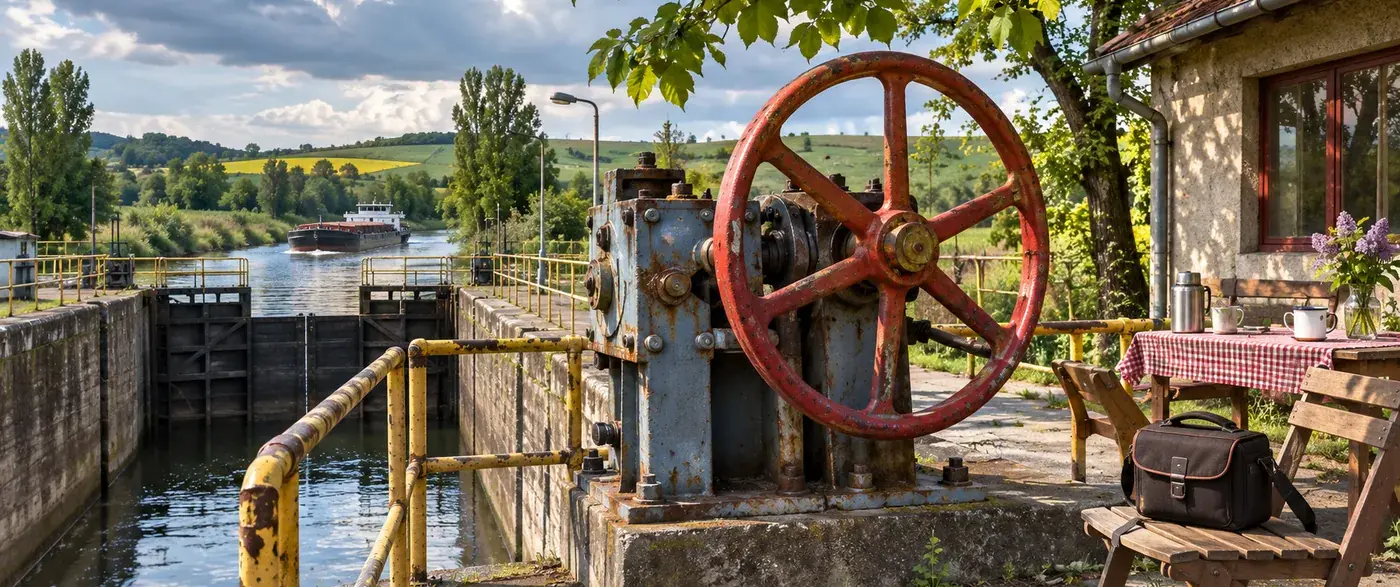
At a reunion of former canal workers, the mechanic who was to take the group photograph is late. He had gone to look for the spot from which you can see the operating wheel from his first day at work. His wife finds the camera case on his chair and learns that nobody has seen him since the last barge went through.
The police and the search team come to the meeting point. The mantrailing dog is given the old cap the man wore until the photograph. His former colleagues draw the shape of the wheel they are looking for, round a plate. One spoke had been welded crooked, and you can recognise it even if the paint no longer has the colour they remember.
Four observations come in from the canal footbridges. In your report you have to identify the message about the spoke, so that the patrol can check pedestrian access at the right mechanism. The times of the calls matter for telling the sheets apart.
You have four calls. Each person calls in once, from a different landmark, and each note belongs to a single call. The times are those of the calls. “Immediately before” means that no other call came in between. At what time and from where did the message “Crooked welded spoke” come?
- Name · Bianca, Mihai, Sanda, Vlad
- Landmark · Sluice Room, Service Bank, North Footbridge, Low Platform
- Note · Square hub, Bronze ring, Wooden handle, Crooked welded spoke
- Time · 12:07, 12:12, 12:17, 12:22
Search log
Field clues
I need a hint
Start with clue 1. Bianca called in at 12:22.
One more hint
For clue 4, try the position pairs 1 and 3 or 2 and 4, in both orders. Rule out the ones that do not fit the other messages.
Workbook
Deduction grid
The grid is optional. You can use it to organise your notes and see which options you have ruled out. If you already have the answer, go straight to the final report.
Pick the cell where the two values you want to compare meet.
How to play: the basics and a worked example
What do I have to do in a case?
- Read the story and the question in the final report: At what time and from where did the message “Crooked welded spoke” come? That tells you what you have to reconstruct.
- Take the clues one at a time. Look for the two items each sentence links and note in the grid what you have learned. Then tick the clue so you remember you have used it. You can reread it at any time.
- If two clues share an item, follow it through both pairings. When you get stuck, you can open “I need a hint”, then “One more hint”.
- When you have a theory, fill in the two fields of the final report. You can send the report even if you left the grid empty. Then press “Check the report”. If the answer doesn't match, reread the clues and try again. Once it is confirmed, read the explanation in “The log, reconstructed”, shown below the report.
How do I correct a mark?
Tap the same cell to go through the three states, in order. You start from a dot. One tap puts ×, another puts ✓, and a third brings the dot back. So from ✓, a single tap clears the mark. The other cells only change when you tap them yourself.
How do I read the big grid in a case?
Above the columns you will see categories such as “Landmark” and “Note”. The rows are on the left. Follow the name on the row across to the column you are interested in and read the pairing as a question. A dot means you haven't noted the answer yet.
The one-match rule applies within each group of columns. After a ✓ you can put × in the other cells on the row and the column of the same group. In another group, the same row can have one more ✓.
Further down, the rows compare the remaining categories with each other. The hatched areas show pairings already covered elsewhere in the table. On a phone, swipe the table sideways to see the next group.
The example below is a made-up case with two dogs, Luna and Nori, who ended up in different places. The first clue says: “Luna did not finish the trail at the jetty.” Luna gets × under Jetty, so the greenhouse is all that is left for her and she gets ✓ there. The second clue says: “The team that reached the greenhouse used the bandana.”
| Reference | Place | Article | ||
|---|---|---|---|---|
| Jetty | Greenhouse | Bandana | Scarf | |
| Luna | ruled out | confirmed | confirmed | unknown |
| Nori | unknown | unknown | unknown | unknown |
| Jetty | Unused group of cells | unknown | unknown | |
| Greenhouse | confirmed | unknown | ||
On the “Greenhouse” row, the ✓ under “Bandana” comes straight from the clue. On the “Luna” row, the ✓ under “Bandana” is your own conclusion: Luna reached the greenhouse, and the team at the greenhouse used the bandana. The two ticks on Luna's row are in different groups.
Swipe the table to the left to see all the columns.
| Sheet | Landmark | Note | Time | |||||||||
|---|---|---|---|---|---|---|---|---|---|---|---|---|
Final report
At what time and from where did the message “Crooked welded spoke” come?
The log, reconstructed
The man had reached the old wheel, but the grille closed behind him. Rescuers hear him answering from beyond the railing. At the group photograph, the mechanic sets the camera on its case and steps into the frame himself.
| Name | Landmark | Note | Time |
|---|---|---|---|
| Vlad | Service Bank | Bronze ring | 12:07 |
| Mihai | Low Platform | Square hub | 12:12 |
| Sanda | North Footbridge | Crooked welded spoke | 12:17 |
| Bianca | Sluice Room | Wooden handle | 12:22 |
Solve another case
More cases of the same level from the collection.
-
 Case 193
Solved
The empty seat at the editing desk
At a film camp, a teenage girl comes back from the forest with the first recordings for the soundtrack.
-
 Case 194
Solved
The rope with the copper thread
Before a rescue techniques demonstration, one of the organisers goes to collect the props and stops answering his phone.
-
 Case 195
Solved
The dove carved in the beam
While measuring a house for the village museum, the architect discovers that one of the beams comes from another homestead.