If you've been exploring scent sports for your dog, you've certainly come across both terms: mantrailing and Nose Work (or K9 Nose Work). At first glance they seem similar - both involve the dog's nose, both are based on following a scent. But in practice they are completely different activities, with distinct purposes, rules, and dynamics.
This is the fundamental difference:
| Mantrailing Nose Work |
| What the dog searches for | A specific person by their unique scent | Target odors (essential oils: Birch, Anise, Clove, Cypress) |
| Scent source | A trail left by a person on the terrain | A container, surface, room, or exterior area |
| Goal | Find the target person and alert the handler | Find the exact location of the target odor |
| Scale of activity | Trails from tens of metres up to 2 km | Defined spaces: boxes, rooms, vehicles, exteriors |
Mantrailing - You Follow a Person
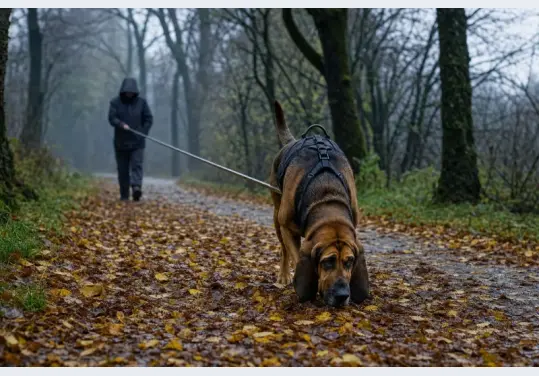
In mantrailing, the dog receives a scent article - an object belonging to a specific person (a glove, a piece of clothing, a used handkerchief). Based on that individual scent, the dog follows the trail that person left behind in the environment.
The trail is real — that person actually walked that path, leaving olfactory molecules on the ground, vegetation, and in the air. The dog isn't following an abstract scent, but reconstructing a story: where did this person go?
Mantrailing can be practiced:
- As a sport and hobby (the human-dog team vs. the trail)
- As a rehabilitation activity for anxious dogs
- As a competition discipline (IRO, TSAC, K9 Hungary exams)
- Operationally — search and rescue dogs on real missions
Nose Work - You Search for a Specific Scent
Nose Work (K9 Nose Work) was developed in the USA by former detection dog trainers and adapted for companion dogs. The dog is trained to recognise a specific odor (usually a particular essential oil) and find the exact location where it is hidden.
Searches take place in controlled spaces:
- Container search - boxes, bags, objects
- Interior search - rooms, furniture
- Exterior search - open-air areas
- Vehicle search - cars, vehicles
The dog indicates the scent's location (usually by sitting or lying down near the source), and the handler confirms the find.
Key Practical Differences1. Space and Environment
- Mantrailing: Open, unpredictable environment - streets, forests, parks, urban centres. The trail can cross any type of terrain.
- Nose Work: Controlled and defined environment, usually inside or around a delimited space.
2. Human-Dog Relationship Dynamics
- Mantrailing: The dog leads, the handler follows. The relationship is one of partnership and trust - you follow the dog's indications, not the other way around.
- Nose Work: The dog works more independently, the handler observes and confirms the find.
3. Scent Complexity
- Mantrailing: The dog follows an individual human scent - extremely complex, composed of thousands of volatile compounds specific to that person. Trails degrade over time and are influenced by weather, terrain, and traffic.
- Nose Work: The target scent is simple and consistent - a pure essential oil, perfectly reproducible from session to session.
4. Distance and Duration
- Mantrailing: Trails from 150 metres (beginner level) up to 2 kilometers (advanced level), with tracks aged hours or even days.
- Nose Work: Smaller search areas, shorter sessions, emphasis on precision.
5. Available Certifications
- Mantrailing: IRO Mantrailing (V/A/B), Mantrailing Hungary K9 (MT1-MT7), TSAC, BH
- Nose Work: NACSW (USA), CNCA (Canada), various national European organisations
Which Is Better for My Anxious or Reactive Dog?
Both are excellent for dogs with behavioural challenges, but with nuances:
Nose Work may be more accessible for highly anxious dogs at first, because:
- The environment is controlled and predictable
- The dog can work alone (without other dogs nearby)
- Sessions are short and frequently offer guaranteed success
Mantrailing brings deeper long-term benefits for anxious dogs, because:
- Gradual exposure to varied environments builds resilience
- Working in open environments provides complete sensory stimulation
- The bond with the handler deepens through genuine collaboration
Many owners start with Nose Work and move on to mantrailing once the dog gains confidence.
Can I Do Both Activities?
Absolutely yes. The two activities don't interfere with each other - on the contrary, they complement one another. A dog that practices both sports becomes more versatile, more focused, and more balanced.
One thing to watch: don't mix the indication behaviours if you want to compete in both disciplines. The dog should clearly know that in mantrailing it searches for a person, while in Nose Work it searches for a specific scent.
Quick Summary
| Criteria Mantrailing Nose Work |
| Starting difficulty | Medium | Easy |
| Requires large space | Yes | Not necessarily |
| Suitable for apartment (training) | Partially | Yes |
| Human-dog bond | Very strong | Strong |
| Practical applicability (SAR) | Yes | Limited |
| Available in Romania | Yes - Mantrailing România | Partially |
Conclusion
If you want an activity that takes your dog into diverse environments, builds an authentic bond between you, and has real applicability in search-and-rescue situations - mantrailing is your choice.
If you prefer a more controlled introduction to scent sports, with small spaces and short sessions - Nose Work can be an excellent first step before moving on to mantrailing.
In either case, your dog's nose is the most powerful tool you have. All you need to do is put it to work.
Want to start mantrailing? Discover what mantrailing is and the first steps in training.