
How to Choose a Harness for Mantrailing - Complete Guide
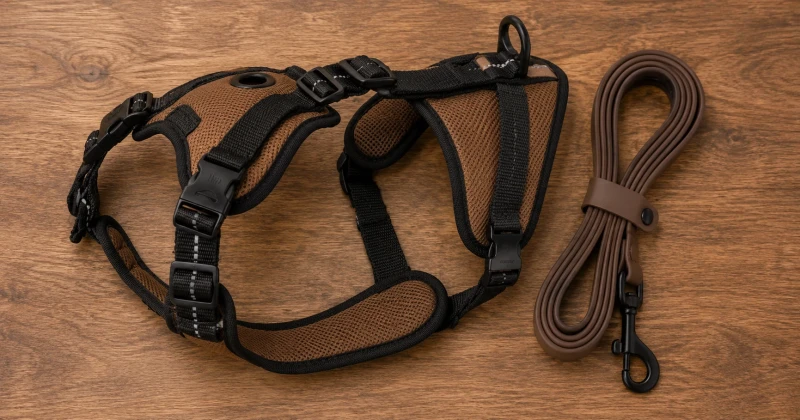
If you had to pick one single piece of essential mantrailing equipment, it would be the harness. Not the leash, not the treat pouch, not the GPS. The harness.
The wrong harness can physically prevent your dog from working properly, cause discomfort or even pain, and turn a good session into a frustrating one. The right harness becomes invisible - your dog doesn't feel it, and you don't think about it.
Why not just any harness works
Unlike a regular walk, mantrailing involves constant forward pull and free shoulder movement. The dog is pulling ahead, nose down, with his whole body weight leaning forward. The leash is under tension most of the time.
Most harnesses you'll find in pet stores are designed to reduce pulling or make it unpleasant for the dog - which is exactly the opposite of what you need. A mantrailing harness has to allow free shoulder movement without any restriction on the front chest, distribute pressure evenly across the chest and back, not restrict breathing, and stay stable on the body when the dog changes direction quickly.
The right type: Y-shape harness
The Y-shape harness is the standard choice for mantrailing and is recommended by most instructors and organizations - IRO, TSAC, K9 Hungary.
What it looks like: one strap passes between the front legs and around the front chest, forming a Y when viewed from the front. Another strap runs across the back, and the leash attachment ring sits on the back between the shoulder blades or slightly higher.
Why it works: the back attachment point lets the dog use his full body weight to pull without any pressure on the neck. The Y-front strap doesn't block the shoulder joints. Force is distributed across the chest and back, not at a single point.
Brands with Y-harnesses suitable for mantrailing: Julius-K9 IDC, Non-stop Dogwear Freemotion, Hurtta Casual, Wildhorn, Baldurinn.
One thing to watch: some harnesses marketed as Y-shape have the front strap sitting too high on the chest or too tight. Always check that the front strap passes between the front legs, not over the shoulder joints.
What to avoid
Anti-pull harness - designed specifically to make pulling uncomfortable or to redirect the dog toward the handler. Exactly the opposite of what you want. A dog working a trail needs to be able to pull.
H or X harness - the front strap sits directly over the shoulder joints and limits range of motion. In dogs that work a lot, this can cause discomfort and, over time, muscle problems.
Front clip harness - useful for training and control, but on a trail it applies force sideways relative to the direction of travel, which destabilizes the dog and creates uneven tension.
Vest harness - covers too much of the body, can overheat the dog, and restricts ventilation. It doesn't allow natural movement of the back muscles.
Which material to choose
Nylon - affordable, easy to find, available in many sizes. It gets wet, holds odors, and gets dirty relatively quickly with regular outdoor use. Good for starting out or for puppies who'll grow out of it anyway.
Biothane - the most popular material among experienced mantrailing practitioners. It's a polyester-based material coated in PVC or TPU: it looks and feels like leather but is completely waterproof. It doesn't absorb water or dirt, wipes clean with a cloth, doesn't hold odors, and stays flexible in cold weather. A quality biothane harness lasts for years. More expensive than nylon and harder to find in physical stores, but the most economical choice long-term.
Natural leather - comfortable and high quality, but needs maintenance and isn't suited for wet terrain. Better for competitions or demonstrations than regular field training.
How to get the right size
This is where most owners go wrong. A harness that's too loose will slide and rotate; one that's too tight restricts movement and causes discomfort.
Measurements you need: chest circumference - measure under the armpits, above the front legs, at the widest point of the chest. This is the main measurement. Front chest circumference - measure just behind the armpits, which matters for the Y front strap.
Once the harness is on, check with the two-finger test: you should be able to slide two fingers comfortably under any strap - if you can't, it's too tight; if more than two fingers slip through easily, it's too loose. Lift the dog's front paws: the harness shouldn't slide forward toward the neck. Grab the leash ring and pull gently sideways: the harness shouldn't rotate significantly on the body. And watch the dog walk: there shouldn't be any rubbing or unusual movement in the front legs.
When to replace the harness
Puppies grow fast - a harness bought at 3 months can be outgrown by 5 months. Many owners buy a cheaper nylon harness for the growth period and invest in a quality one once the dog reaches adult size. Signs the harness no longer fits: you can't adjust it tight enough, the front straps are riding up too high on the chest or shoulders, or the attachment ring is no longer sitting straight on the center of the back.
A quality harness for an adult dog lasts three to five years or more with proper care. Check the stitching at the attachment ring periodically (it takes the most stress), the buckles, and the overall condition of the material.
A few common questions
My dog has always worn a walking harness. Do I really need a new one? If the current harness has a back attachment ring (not front clip) and isn't anti-pull, you can test with it for the first few sessions. If your dog seems restricted or the harness slides around, it's worth investing in one made for mantrailing.
Are there recommended harnesses available in Romania? Julius-K9 IDC is available in specialty pet stores. Biothane harnesses are easiest to order from German or Austrian websites or from Etsy sellers who specialize in them. For custom biothane harnesses cut to your dog's exact measurements, there are online makers who work to order.
Do I need a separate harness for mantrailing and one for walks? It's not required, but it helps. Dogs associate equipment with activities - a dedicated mantrailing harness can become a positive trigger that tells your dog work is about to start. Many dogs get noticeably excited the moment they see their mantrailing harness.
There's no universally perfect harness - dogs have different body shapes, and what works great on a Labrador may not suit a Dachshund at all. But if you follow the basics from this guide - Y-shape, back attachment, two fingers under the straps, material suited to your use - you'll make a solid choice.
If you're not sure what size or model works for your dog, bring him to one of the Mantrailing Romania introductory sessions. Our instructors can check your existing equipment or recommend specific options.