So you've decided to give mantrailing a go with your dog. That's a great choice - it's honestly one of the most rewarding things you can do together. But before your first session, it's completely normal to have questions: What do I bring? How does it work? What exactly is my dog doing out there? And what am I supposed to do?
This guide covers all of that.
What a Mantrailing Session Actually Looks Like
Every session involves three roles:
- Handler - that's you, the person holding the line and following wherever your dog goes
- Victim / Layer - the person your dog is searching for, who walked the trail before you arrived
- Observer - someone who already knows the trail and follows the team for safety and to give feedback afterwards
At beginner level, trails are short (150-300 metres), kept simple, and run in quiet areas. The layer leaves a few minutes before you, walks a set route, and waits at the end.
You're handed a scent article - something that belongs to the layer and has been worn against their skin recently (a glove, a sock, a handkerchief). Your dog sniffs it, locks onto the trail, and leads the way. You follow.
What Equipment You Need for Your First SessionThe Essentials
1. Y-shaped harness
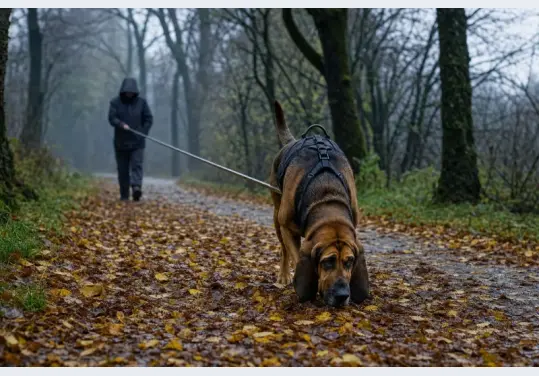
This is the single most important piece of kit. It needs to spread pressure evenly across your dog's chest and give their shoulders complete freedom to move. Stay away from no-pull or anti-tug harnesses - in mantrailing, pulling forward is natural and exactly what you want.
For a deeper look, check our dedicated guide: how to choose a harness for mantrailing.
2. Long line (5-10 metres)
Your dog needs room to work. A standard 2-metre lead restricts their movement and throws them off. The typical mantrailing line runs 5-7 metres. Good materials: biothane (waterproof and easy to clean) or rope.
3. Scent article
This comes from the target person - something worn directly against their skin in the last few hours. Store it in a plastic bag or glass container to hold the scent in. Don't touch someone else's scent article with bare hands before the session starts.
4. High-value treats
Bring whatever your dog goes absolutely crazy for - bits of meat, cheese, sausage. For this first session especially, the reward needs to feel worth it to them. If your dog is more toy-driven than food-driven, bring their favourite toy instead.
Nice to Have (not essential for day one)
- Water bottle for your dog
- Treat pouch
- Gloves - especially useful in cold weather or on rough ground
- Comfortable clothes and footwear suited to the terrain
How a First Session Unfolds, Step by StepStep 1 - Presenting the scent article
Right before the start, hold the scent article near your dog's nose (being careful not to touch the inside yourself). Your dog takes a sniff and their brain locks in: this is who I'm looking for.
Then comes your start cue - a word or phrase you'll use every single session to signal the search is beginning. "Search!", "Find it!", or anything else works, as long as you stick to the same one every time.
Step 2 - Your dog picks up the trail
In the first few sessions, your dog may look a bit lost for a moment or two. Don't panic - that's normal. Let them sniff around the start area freely, because that's where the layer's scent is most concentrated.
When they lock on, you'll see it clearly: the head drops to the ground or comes up to scent the air, the tail and ears shift into a different gear, the movement becomes deliberate and directed. Your dog knows where they're going.
Step 3 - You follow, you don't lead
This is the most important principle in the whole sport, and the hardest thing for a new handler to actually do in practice.
Every instinct you have will tell you to guide your dog, to steer them, to second-guess them. Don't. Your dog has information you simply don't have. If they're heading left and you're sure the layer went right - trust your dog and keep following.
Your job during this phase is to:
- Keep the line out long, with as little tension as possible
- Follow without pulling your dog back or pushing them to go faster
- Pay attention to their signals - where they linger, where they hesitate, where they pick up speed
- Stay relaxed - dogs pick up on handler anxiety faster than you'd expect
Step 4 - The find
When your dog reaches the layer, the reaction is hard to miss - they might bark, jump up, or sniff the person all over with obvious excitement. The moment they find them, reward immediately and celebrate properly.
Always reward at the person, never on the trail. The whole point is for your dog to connect "finding the person" with the best thing that can happen to them. Play, praise, food - give it everything you've got right there.
Step 5 - Debrief
Once the session is done, talk it through with the observer: where did the dog follow the trail accurately, where did they veer off, what seemed to be influencing their work. This is genuinely where most of the learning happens.
Common Beginner Mistakes (and How to Avoid Them)"I steered my dog toward where I thought the person was"
This is by far the most common one. If your dog loses the trail and you step in to point them in the right direction, you're teaching them that you hold the answers - not their nose. The next time they get stuck, they'll look to you instead of trusting their own instincts.
Fix: If your dog seems stuck, go back to the last spot where they were clearly working and let them start over from there.
"I shortened the line to feel more in control"
A short line limits your dog's head movement and gets in the way of their ability to follow ground scent properly. They pull, you pull back, and that tension throws everything off.
Fix: Keep at least 5 metres out and practise managing a longer line - not shortening it when things feel uncertain.
"I rewarded on the trail, not at the find"
Treats given along the way teach your dog that the trail itself is the rewarding part, not finding the person. Over time that can make them slower and less motivated to push all the way to the end.
Fix: Save the biggest reward, his favourite treat and the celebration of the day, for the moment of the find.
"I pushed my dog to keep going when they were clearly tired"
Two short, positive sessions will always do more for your dog than one long, exhausting one. A tired dog just can't work with their nose effectively.
Fix: On your first session, do 1-2 trails at most. Stop while your dog is still keen, not after they've switched off.
What to Expect After Your First Session
It won't be perfect - and it doesn't need to be. Your dog might:
- Lose the trail and find it again several times - completely normal
- Look confused at the start - completely normal
- Get distracted by other smells along the way - completely normal
- Go straight to the person without any hesitation - brilliant, but unusual for a first session
What actually matters in the first session is not the performance - it's the positive experience. Your dog needs to finish happy, well-rewarded, and wanting to do it again. If that's what happened, the session was a success. Full stop.
Where to Run Your First Session
Ideally you want somewhere calm and already familiar to your dog - a quiet park, a less-used footpath, a green space they know well. Avoid anywhere busy with heavy foot traffic or lots of other dogs.
As your dog builds experience, you'll gradually make things more challenging - streets, town centres, woodland, industrial zones.
If you want to learn mantrailing properly from the very beginning, come and join our community. Find out about training sessions run by Mantrailing Romania and bring your dog along.
To Wrap Up
Your first mantrailing session doesn't need to be perfect. It just needs to be positive.
Get the right equipment sorted, be patient with your dog, follow their lead with real confidence, and reward big at the find. From there, each session builds on the last.
Your dog's nose already knows what it's doing. Your only job is to trust it.
Ready to take the next step? Read about basic mantrailing exercises and the equipment you'll need to get started.