Mantrailing is a fascinating activity that lies at the intersection of canine sport, working discipline, and a deeply enriching experience of connection between human and dog. Although still relatively little known in Romania, mantrailing is rapidly gaining popularity worldwide due to its multiple benefits: mental and emotional development for the dog, balance and confidence for the handler, and real-life applications in search and rescue.
What Is Mantrailing?
Mantrailing is the dog’s ability to identify and follow the unique scent of a specific person, starting from a personal item belonging to that individual (known as a scent article). Unlike other forms of tracking, the dog is not following visible footprints or a general ground scent, but the individual human scent that disperses in the environment under the influence of wind, temperature, humidity, and surface type.
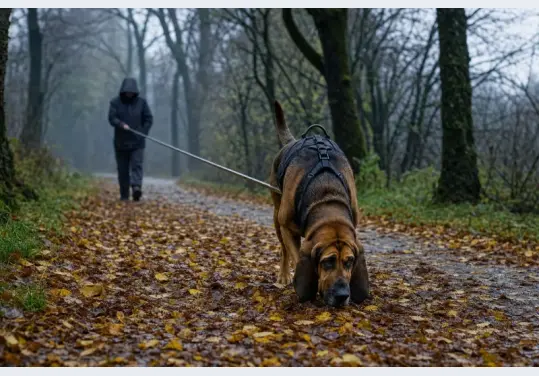
The dog wears a harness and a long line, while the handler accompanies the dog without directing it. The handler’s role is to read the dog’s body language, trust its decisions, and provide correct support throughout the search.
Mantrailing can be practiced in a wide variety of environments: busy urban areas, forests, fields, parking lots, buildings, or industrial zones. Each training session is different, making this discipline extremely dynamic and engaging.
Why Is Mantrailing So Valuable for the Dog?
The dog’s primary tool is its nose. It is estimated that dogs have between 200 and 300 million olfactory receptors, compared to approximately 5 million in humans. Mantrailing fully capitalizes on this natural ability, offering the dog an activity that is deeply satisfying on an instinctual level.
Benefits for the dog include:
Intense mental stimulation, which is far more tiring and beneficial than repetitive physical exercise.
Increased self-confidence, especially for shy, anxious, or reactive dogs.
Autonomy and decision-making, as the dog leads the search.
Reduced stress and behavioural issues, by channeling energy into a structured and meaningful activity.
An essential aspect of mantrailing is that it is suitable for almost any dog: puppies, seniors, small or large breeds, purebred or mixed. Speed or strength does not matter—only the willingness to work with the nose.
Benefits of Mantrailing for the Handler
Mantrailing is not only about the dog; it is equally about the handler. Practicing this discipline profoundly changes how people perceive their dogs and their relationship with them.
Benefits for the handler include:
- Learning to read canine body language in a practical and in-depth way.
- Improved patience and focus.
- Letting go of the need for control, leading to a more balanced relationship.
- Building mutual trust, where the dog becomes a true partner, not just a performer.
- Many handlers discover that mantrailing has an almost therapeutic effect: it requires presence, adaptability, and trust in the process.
Sport Mantrailing vs. Operational Mantrailing
It is important to note that mantrailing can be practiced both as a recreational or sport activity and for operational purposes (searching for missing persons). In the sport context, the focus is on developing the dog–handler team, technique, and enjoyment of the process.
In operational work, training is far more complex and standardised, and dogs are regularly evaluated to ensure reliability in real-life situations. Even so, the foundation remains the same: respect for the dog, accurate reading of its signals, and consistent training.
Why Start Mantrailing Now?
In a world where dogs are often mentally under-stimulated and people are constantly rushed, mantrailing offers a rare balance. It is an activity that does not demand performance, but involvement. Not perfection, but consistency.
By practicing mantrailing, you:
- give your dog a real purpose,
- build a relationship based on trust,
- discover an invisible world guided by scent,
- and become part of a community united by the same passion.
Mantrailing is not just a sport. It is a shared journey, where every trail tells a story, and every search strengthens the bond between you and your dog.
If you want to see your dog working with joy, focus, and determination—and to learn, in turn, to truly trust your dog—mantrailing is undoubtedly an experience worth embracing.